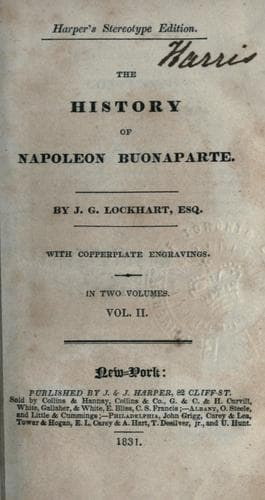
The History of Napoleon BuonaparteLockhart, J. G. (John Gibson)
History
The History of Napoleon Buonaparte
Lockhart, J. G. (John Gibson)
France -- Kings and rulers -- Biography; Napoleon I, Emperor of the French, 1769-1821
The battle of Eckmuhl, however, diffused
new awe all over the north of Germany. The troops of Saxony checked the
Duke of Brunswick's progress, and Schill's heroic band were at last shut
up in Stralsund, where their leader perished in a sortie; thus, and only
thus, escaping the vengeance of Napoleon.
Among the mountains of the Tyrol, the native zeal of a few hardy
peasants achieved more than all the mighty population of Germany. This
ancient province of the house of Austria had been, in sinful violation
of all the rights of mankind, transferred to the hated yoke of Bavaria,
by the treaty of Presburg. The mountaineers no sooner heard that their
rightful sovereign was once more in arms against Napoleon, than they
rose (early in April), under the guidance of Hofer, a gallant peasant,
seized the strong passes of their country, and, in the course of four
days, made every French and Bavarian soldier quartered among them a
prisoner,--with the exception of the garrison of the fortress of
Kufstein. Napoleon caused Lefebre to march into the country with his
division; but Hofer posted his followers on the edge of precipices, from
which they fired on the French columns with the skill of practised
marksmen, and rolled down torrents of stones with such effect, that
Lefebre was compelled to retreat. Austria, however, having enough of
work at home, could not afford to sustain the efforts of these heroic
peasants by any detachment of regular troops. On the retirement of
Lefebre, they issued from their hills and wasted the neighbouring
territory of Bavaria; but the general issue of the campaign left them at
the mercy of Napoleon, who suppressed the insurrection, finally, by
overwhelming numbers, and avenged it by massacring Hofer and all who had
taken a prominent part in the cause of freedom.
These popular movements, however, could not be regarded with
indifference by him who had witnessed and appreciated the character of
the Spanish insurrection. Napoleon well knew, that unless he concluded
the main contest soon, the spirit of Schill and Hofer would kindle a
general flame from the Rhine to the Elbe; and he therefore desired
fervently that the Austrian generalissimo might be tempted to quit the
fastnesses of Bohemia, and try once more the fortune of a battle.
The Archduke, having re-established the order and recruited the numbers
of his army, had anticipated these wishes of his enemy, and was already
posted on the opposite bank of the Danube, which river, being greatly
swollen, and all the bridges destroyed, seemed to divide the two camps,
as by an impassable barrier.
Public-domain text, read in full here on John Shaqi.
Reviews
Reviews
No reviews yet
Be the first to share your thoughts on this work.
Elsewhere in the archive
Join the Discussion
Join the discussion
Sign in to leave a comment or review.
Sign InorCreate an account