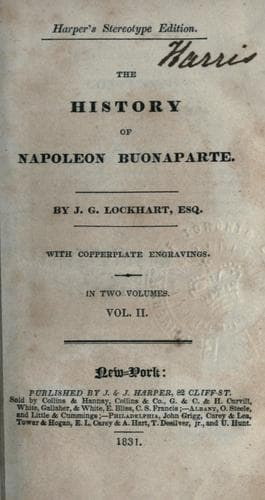
The History of Napoleon BuonaparteLockhart, J. G. (John Gibson)
History
The History of Napoleon Buonaparte
Lockhart, J. G. (John Gibson)
France -- Kings and rulers -- Biography; Napoleon I, Emperor of the French, 1769-1821
Napoleon determined to pass it; and after an unsuccessful attempt at
Nussdorff, met with better fortune at Ebersdorff, where the river is
broad and intersected by a number of low and woody islands, the largest
of which bears the name of Lobau. On these islands Napoleon established
the greater part of his army, on the 19th of May, and on the following
day made good his passage, by means of a bridge of boats, to the left
bank of the Danube; where he took possession of the villages of Asperne
and Essling, with so little show of opposition, that it became evident
the Archduke wished the inevitable battle to take place with the river
between his enemy and Vienna.
On the 21st, at daybreak, the Archduke appeared on a rising ground,
separated from the French position by an extensive plain; his whole
force divided into five heavy columns, and protected by not less than
200 pieces of artillery. The battle began at four p.m., with a furious
assault on the village of Asperne; which was taken and retaken several
times, and remained at nightfall in the occupation, partly of the
French, and partly of the assailants, who had established themselves in
the church and churchyard. Essling sustained three attacks also; but
there the French remained in complete possession. Night interrupted the
action; the Austrians exulting in their partial success; Napoleon
surprised that he should not have been wholly victorious. On either side
the carnage had been terrible, and the pathways of the villages were
literally choked with the dead.
Next morning the battle recommenced with equal fury; the French
recovered the church of Asperne; but the Austrian right wing renewed
their assaults on that point with more and more vigour, and in such
numbers, that Napoleon guessed the centre and left had been weakened for
the purpose of strengthening the right. Upon this he instantly moved
such masses, _en échelon_, on the Austrian centre, that the Archduke's
line was shaken; and for a moment it seemed as if victory was secure.
Public-domain text, read in full here on John Shaqi.
Reviews
Reviews
No reviews yet
Be the first to share your thoughts on this work.
Elsewhere in the archive
Join the Discussion
Join the discussion
Sign in to leave a comment or review.
Sign InorCreate an account