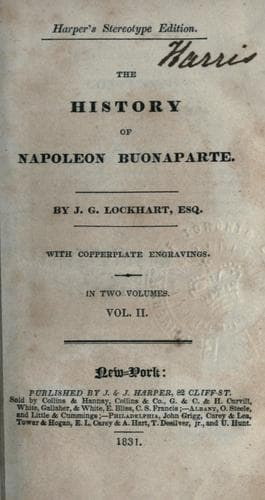
The History of Napoleon BuonaparteLockhart, J. G. (John Gibson)
History
The History of Napoleon Buonaparte
Lockhart, J. G. (John Gibson)
France -- Kings and rulers -- Biography; Napoleon I, Emperor of the French, 1769-1821
Here, on the 6th of July, the final and decisive battle was fought. The
Archduke had extended his line over too wide a space; and this old error
enabled Napoleon to ruin him by his old device of pouring the full shock
of his strength on the centre. The action was long and bloody: at its
close there remained 20,000 prisoners, besides all the artillery and
baggage, in the hands of Napoleon. The Archduke fled in great confusion
as far as Znaim, in Moravia. The Imperial Council perceived that further
resistance was vain: an armistice was agreed to at Znaim; and Napoleon,
returning to Schoenbrunn, continued occupied with the negotiation until
October.
In this fierce campaign none more distinguished himself than Lannes,
Duke of Montebello. At Ratisbonne he headed in person the storming
party, exclaiming, "Soldiers, your general has not forgotten that he was
once a grenadier." At the battle of Asperne his exertions were
extraordinary. He was struck, towards the close of the day, by a
cannon-shot, which carried off both his legs. The surgeons, on examining
the wound, declared it mortal. He answered them with angry imprecations,
and called with frantic vehemence for the Emperor. Napoleon came up, and
witnessed the agonies of the dying marshal, who blasphemed heaven and
earth that he should be denied to see the end of the campaign. Thus
fell Lannes, whom, for his romantic valour, the French soldiery
delighted to call the Roland of the camp.
The war, meanwhile, had been pursued with mixed fortune in the
Peninsula. Zaragossa, after sustaining another siege with fortitude not
unworthy of the first, was at length compelled to surrender in the month
of February. Sir Arthur Wellesley, being restored to the command of the
British army in Portugal, landed at Lisbon on the 22nd of April, and
immediately marched upon Oporto, which Soult had occupied early in the
year. Soult was defeated under the walls of the town, and forthwith
began his retreat towards Galicia, which he effected under circumstances
as miserable as had attended Sir John Moore's march on Coruña in the
preceding campaign. Sir Arthur was prevented from urging the pursuit of
Soult by the intelligence that Marshal Victor was laying Andalusia
waste, being opposed only by Cuesta, a bigoted old general, and an army
which had lost heart by repeated disasters. The English leader perceived
that if he marched into Galicia, Victor must possess the means of
instantly re-occupying Portugal; and resolved, in place of following
Soult, to advance towards this more formidable enemy. He effected a
junction with Cuesta at Oropesa, on the 20th of July, and marched along
the Tagus towards the position of Victor. He, however, having a force at
least double that of Wellesley, assumed the offensive, and attacked the
allies, on the 28th, at Talaveyra de la Reyna. The battle ended in the
total defeat and repulsion of Victor; but Wellesley found it impossible
Public-domain text, read in full here on John Shaqi.
Reviews
Reviews
No reviews yet
Be the first to share your thoughts on this work.
Elsewhere in the archive
Join the Discussion
Join the discussion
Sign in to leave a comment or review.
Sign InorCreate an account