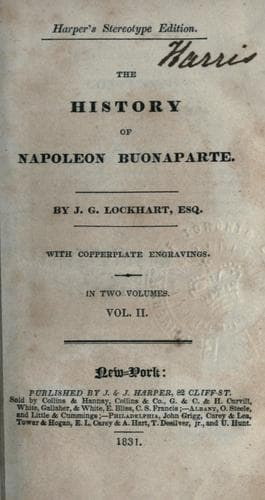
The History of Napoleon BuonaparteLockhart, J. G. (John Gibson)
History
The History of Napoleon Buonaparte
Lockhart, J. G. (John Gibson)
France -- Kings and rulers -- Biography; Napoleon I, Emperor of the French, 1769-1821
to advance further into Spain, because Ney, Soult and Mortier were
assembling their divisions, with the view of coming between him and
Portugal. The English retired, therefore, to Badajos, and thence to the
Portuguese frontier.
On the eastern side of the Peninsula, Blake, advancing with the view of
recovering Zaragossa, was met on the 19th of June by Marshal Suchet,
Duke of Albufera, and totally routed. The central Spanish army, under
Ariezaga, attempted, with equal ill-fortune, to relieve Madrid. King
Joseph, accompanied by Soult, Victor, and Mortier, met them at Ocaña on
the 19th November, and broke them utterly. In December Girona
surrendered to Augereau; and the intrusive King appeared to be in
possession of far the greater part of Spain. But his command extended
no further than the actual presence of his brother's legions. Wherever
they were posted, all was submission; beyond their lines the country
remained as hostile as ever. The soldiery of the defeated armies
dispersed themselves in small bands, watching every opportunity to
surprise detachments and cut off supplies; and, in spite of all their
victories, the situation of the invaders became every hour more
embarrassing. In Portugal, meanwhile, the English general (created Lord
Wellington after the battle of Talaveyra) was gradually organising a
native force not unworthy of acting under his banners; and on that side
it was obvious that, unless Napoleon made some extraordinary exertions,
the French cause was wholly undone.
Portugal was safe; and the character of the British army had been raised
by another splendid victory in Spain; but these were trivial advantages
compared with what Lord Wellington might have achieved, had his
government placed him, as they could easily have done, at the head of an
army of 80,000 or 100,000 men, while Napoleon was occupied with the
campaign of Essling and Wagram. Instead of strengthening Wellington's
hands in an efficient manner, the English cabinet sent 40,000 troops,
under the command of the Earl of Chatham, an indolent or incompetent
general, to seize the isle of Walcheren, and destroy the shipping and
works at the mouth of the Scheld; nor was this ill-judged expedition
despatched from Britain until the first of August, three weeks after the
decisive battle of Wagram had been fought and won. Lord Chatham took
Flushing, and fixed his headquarters at Middleburg; but Bernadotte
(Prince of Ponte Corvo) put Antwerp into such a state of defence that
the plan of besieging that city was, ere long, abandoned. A pestilence,
meantime, raged among the marches of Walcheren; the English soldiers
were dying by thousands. The news of the armistice of Znaim arrived; and
Lord Chatham abandoned his conquests. A mere skeleton of his army
returned to their own country, from the most disastrous expedition which
England had undertaken since that of Carthagena, seventy years before.
Public-domain text, read in full here on John Shaqi.
Reviews
Reviews
No reviews yet
Be the first to share your thoughts on this work.
Elsewhere in the archive
Join the Discussion
Join the discussion
Sign in to leave a comment or review.
Sign InorCreate an account