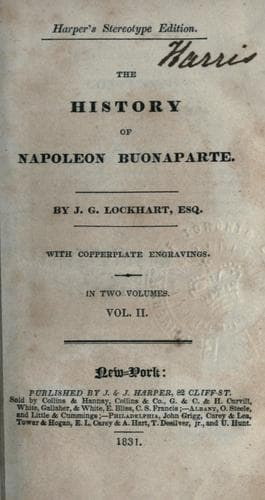
The History of Napoleon BuonaparteLockhart, J. G. (John Gibson)
History
The History of Napoleon Buonaparte
Lockhart, J. G. (John Gibson)
France -- Kings and rulers -- Biography; Napoleon I, Emperor of the French, 1769-1821
It was during his residence at Schoenbrunn that a quarrel, of no short
standing, with the Pope reached its crisis. The very language of the
Consular Concordat sufficiently indicated the reluctance and pain with
which the head of the Romish church acquiesced in the arrangements
devised by Buonaparte, for the ecclesiastical settlement of France; and
the subsequent course of events, but especially in Italy and in Spain,
could hardly fail to aggravate those unpleasant feelings. In Spain and
in Portugal, the resistance to French treachery and violence was mainly
conducted by the priesthood; and the Pope could not contemplate their
exertions without sympathy and favour. In Italy, meantime, the French
Emperor had made himself master of Naples, and of all the territories
lying to the north of the papal states; in a word, the whole of the
peninsula was his, excepting only that, narrow central stripe which
still acknowledged the temporal sovereignty of the Roman Pontiff. This
state of things was necessarily followed by incessant efforts on the
part of Napoleon to procure from the Pope a hearty acquiescence in the
system of the Berlin and Milan decrees; and thus far he at length
prevailed. But when he went on to demand that his holiness should take
an active part in the war against England, he was met by a steady
refusal. Irritated by this opposition, and, perhaps, still more by his
suspicion that the patriots of the Spanish Peninsula received secret
support from the Vatican, Buonaparte did not hesitate to issue a decree
in the following words: "Whereas the temporal sovereign of Rome has
refused to make war against England, and the interests of the two
kingdoms of Italy and Naples ought not to be intercepted by a hostile
power; and whereas the donation of Charlemagne, _our illustrious
predecessor_, of the countries which form the Holy See, was for the good
of _Christianity_, and not for that of the _enemies of our holy
religion_, we, therefore, decree that the duchies of Urbino, Ancona,
Macerata, and Camarino, be for ever united to the kingdom of Italy."
The seaports of the papal territory were forthwith occupied by French
troops, but Pius remained for some time in undisturbed possession of
Rome itself. On his return from Spain, however, Napoleon determined to
complete his work in Italy, ere he should begin the inevitable campaign
with Austria. General Miollis, therefore, took military possession of
Rome in February, 1809; the Pope, however, still remaining in the
Vatican, and attended there as usual by his own guards.
Public-domain text, read in full here on John Shaqi.
Reviews
Reviews
No reviews yet
Be the first to share your thoughts on this work.
Elsewhere in the archive
Join the Discussion
Join the discussion
Sign in to leave a comment or review.
Sign InorCreate an account