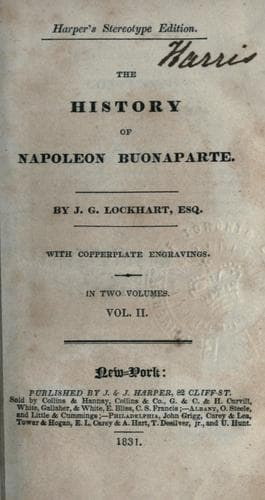
The History of Napoleon BuonaparteLockhart, J. G. (John Gibson)
History
The History of Napoleon Buonaparte
Lockhart, J. G. (John Gibson)
France -- Kings and rulers -- Biography; Napoleon I, Emperor of the French, 1769-1821
This was the first public intimation of a measure which had for a
considerable period occupied much of Napoleon's thoughts, and which,
regarded at the time (almost universally) as the very master-stroke of
his policy, proved in the issue no mean element of his ruin.
Josephine had loved Napoleon, and been beloved passionately by him in
his youth. She had shared his humbler fortune; by her connections in
Paris, and especially by her skilful conduct during his Egyptian
expedition, and immediately afterwards, she had most materially assisted
him in the attainment of the sovereign dignity: she had subsequently
adorned his court, and gratified his pride, by the elegance of her
manners, and won to herself the attachment of his people, by her sincere
good nature and active benevolence. Her power over him was known to be
great, and no one ever doubted but that it had uniformly been exerted on
the side of mercy. She was considered as the good angel who, more
frequently and effectually than any influence besides, interfered to
soothe the fierce passions and temper the violent acts of her lord. Her
devotion to him was perfect: she partook his labours as far as he would
permit her to do so, submitted to all his caprices, and, with a dark
presentiment that his ambition would one day cast her aside, continued
to centre the whole of her existence in the contemplation of his glory.
Long before Napoleon assumed the imperial title, his hopes of offspring
from this union were at an end; and, at least from the hour in which his
authority was declared to be hereditary, Josephine must have begun to
suspect that, in his case also, the ties of domestic life might be
sacrificed to those views of political advantage, which had so often
dissolved the marriages of princes. For a moment she seems to have
flattered herself that Napoleon would be contented to adopt her son: and
Eugene, as we have seen, was indeed announced, at the period of his
alliance with the royal family of Bavaria, as the successor to the
throne of Italy, in case his father-in-law should leave no second son to
inherit it. Louis Buonaparte afterwards wedded Hortense de Beauharnois,
and an infant son, the only pledge of their ill-assorted union, became
so much the favourite of Napoleon, that Josephine, as well as others,
regarded this boy as the heir of France. But the child died early; and
the Emperor began to familiarise himself with the idea of dissolving his
own marriage.
Public-domain text, read in full here on John Shaqi.
Reviews
Reviews
No reviews yet
Be the first to share your thoughts on this work.
Elsewhere in the archive
Join the Discussion
Join the discussion
Sign in to leave a comment or review.
Sign InorCreate an account