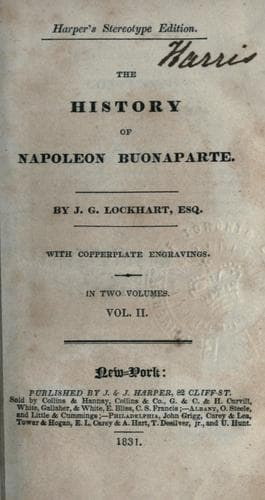
The History of Napoleon BuonaparteLockhart, J. G. (John Gibson)
History
The History of Napoleon Buonaparte
Lockhart, J. G. (John Gibson)
France -- Kings and rulers -- Biography; Napoleon I, Emperor of the French, 1769-1821
The treaty with Austria was at last signed at Schoenbrunn on the 14th of
October. The Emperor Francis purchased peace by the cession of Salzburg,
and a part of Upper Austria, to the Confederation of the Rhine; of part
of Bohemia to the King of Saxony, and of Cracow and western Galicia to
the same Prince, as Grand Duke of Warsaw; of part of eastern Galicia to
the Czar; and to France herself, of Trieste, Carniola, Fruili, Villach,
and some part of Croatia and Dalmatia. By this act, Austria gave up in
all territory to the amount of 45,000 square miles, with a population of
nearly four millions; and Napoleon, besides gratifying his vassals and
allies, had completed the connection of the kingdom of Italy with his
Illyrian possessions, obtained the whole coasts of the Adriatic, and
deprived Austria of her last seaport. Yet, when compared with the signal
triumphs of the campaign of Wagram, the terms on which the conqueror
signed the peace were universally looked upon as remarkable for
moderation; and he claimed merit with the Emperor of Russia on the score
of having spared Austria in deference to his personal intercession.
Buonaparte quitted Vienna on the 16th of October; was congratulated by
the public bodies of Paris, on the 14th of November, as "the greatest of
heroes, who never achieved victories but for the happiness of the
world"; and soon after, by one of the most extraordinary steps of his
personal history, furnished abundant explanation of the motives which
had guided his diplomacy at Schoenbrunn.
CHAPTER XXVII
Napoleon divorces Josephine--Marries the Archduchess Maria
Louisa--Deposes Louis Buonaparte--Annexes Holland and the whole
Coast of Germany to France--Revolution in Sweden--Bernadotte
elected Crown Prince of Sweden--Progress of the War in the
Peninsula--Battle of Busaco--Lord Wellington retreats to the Lines
of Torres Vedras.
The treacherous invasion of Spain, and the imprisonment of the Pope,
were but the first of a series of grand political errors, destined to
sap the foundations of this apparently irresistible power. On his return
to Paris, Napoleon proudly proclaimed to his senate, that no enemy
opposed him throughout the continent of Europe--except only a few
fugitive-bands of Spanish rebels, and "the English leopard"[60] in
Portugal, whom ere long he would cause to be chased into the sea. In the
meantime, the Pensinula was too insignificant an object to demand either
his own presence, or much of their concern: the general welfare of the
empire called on them to fix their attention on a subject of a very
different nature; namely, the situation of the imperial family. "I and
my house," said Napoleon, "will ever be found ready to sacrifice
everything, even our own dearest ties and feeling, to the welfare of the
French people."
Public-domain text, read in full here on John Shaqi.
Reviews
Reviews
No reviews yet
Be the first to share your thoughts on this work.
Elsewhere in the archive
Join the Discussion
Join the discussion
Sign in to leave a comment or review.
Sign InorCreate an account