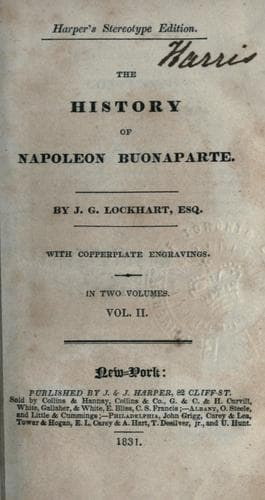
The History of Napoleon BuonaparteLockhart, J. G. (John Gibson)
History
The History of Napoleon Buonaparte
Lockhart, J. G. (John Gibson)
France -- Kings and rulers -- Biography; Napoleon I, Emperor of the French, 1769-1821
Events of the year 1811--Birth of the King of Rome--Disgrace of
Fouché--Discontents in France--Relations with Russia--Licence
System--Napoleon prepares for War with Russia--The Campaign in the
Peninsula--Massena's Retreat--Battle of Fuentes d'Onor--Lord
Wellington blockades Ciudad Rodrigo--Retreats--Joseph wishes to
Abdicate.
On the 20th of April, 1811, Napoleon's wishes were crowned by the birth
of a son. The birth was a difficult one, and the nerves of the medical
attendant were shaken. "She is but a woman," said the Emperor, who was
present: "treat her as you would a _Bourgeoise_ of the _Rue St. Denis_."
The accoucheur at a subsequent moment withdrew Napoleon from the couch,
and demanded whether, in case one life must be sacrificed, he should
prefer the mother's or the child's. "The mother's," he answered; "it is
her right!" At length the child appeared, but without any sign of life.
After the lapse of some minutes a feeble cry was heard, and Napoleon
entering the ante-chamber in which the high functionaries of the state
were assembled, announced the event in these words: "It is a King of
Rome."
The birth of the heir of Napoleon was received with as many
demonstrations of loyal enthusiasm as had ever attended that of a
Dauphin; yet, from what has been said as to the light in which various
parties of men in France from the beginning viewed the Austrian
alliance, it may be sufficiently inferred that the joy on this occasion
was far from universal. The royalists considered the event as fatal to
the last hopes of the Bourbons; the ambitious generals despaired of any
future dismemberment of the empire: the old republicans, who had endured
Buonaparte's despotic power as the progeny of the revolution, looked
forward with deep disgust to the rule of a dynasty proud of sharing the
blood of the haughtiest of all the royal houses of Europe, and
consequently more likely to make common cause with the little band of
hereditary sovereigns than with the people. Finally, the title, "King of
Rome," put an end to the fond hopes of the Italians, who had been taught
by Napoleon to expect that, after his death, their country should
possess a government separate from France; nor could the same title fail
to excite some bitter feelings in the Austrian court, whose
heir-apparent under the old empire had been styled commonly "The King of
the Romans." For the present, however, both at home and abroad, the
event was naturally looked on as adding much strength to the throne of
Napoleon.
Public-domain text, read in full here on John Shaqi.
Reviews
Reviews
No reviews yet
Be the first to share your thoughts on this work.
Elsewhere in the archive
Join the Discussion
Join the discussion
Sign in to leave a comment or review.
Sign InorCreate an account