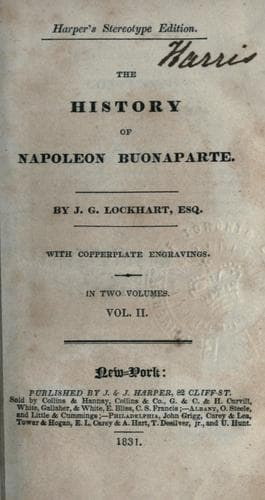
The History of Napoleon BuonaparteLockhart, J. G. (John Gibson)
History
The History of Napoleon Buonaparte
Lockhart, J. G. (John Gibson)
France -- Kings and rulers -- Biography; Napoleon I, Emperor of the French, 1769-1821
He, thus called on to review with new seriousness the whole condition
and prospects of his empire, appears to have felt very distinctly that
neither could be secure, unless an end were, by some means, put to the
war with England. However he might permit himself to sneer at his great
enemy in his public addresses from the throne, and in his bulletins,
Napoleon had too much strength of mind not to despise those who, in any
of their private communications, had the meanness to affect acquiescence
in such views. When Denon brought him, after the battle of Wagram, the
design of a medal representing an eagle strangling a leopard, Buonaparte
rebuked and dismissed the flatterer. "What," said he, "strangling the
leopard! There is not a spot of the sea on which the eagle dares show
himself. This is base adulation. It would have been nearer the truth to
represent the eagle as choked by the leopard."
He sent a private messenger to London to ascertain from personal
communication with the Marquess Wellesley, then minister for foreign
affairs, on what terms the English government would consent to open a
formal negotiation; but this attempt was baffled by a singular
circumstance. Fouché, having derived new audacity from the results of
his extraordinary conversation with Josephine, on the subject of the
divorce, had ventured to send a dependent of his own to London, for the
purpose of sounding Lord Wellesley on the question of preliminaries; not
doubting that could he give distinct information on this head to his
master, without having in any degree compromised the imperial dignity,
the service would be considered as most valuable. But Lord Wellesley,
beset, at the same time, and on the same very delicate topic, by two
different persons, neither of whom produced any proper credentials, and
who denied all knowledge of each other, conceived, very naturally, that
they were mere adventurers if not spies, and at once broke off his
communications with both. Napoleon, on discovering this intrigue,
summoned Fouché to his presence. "So, sir," said he, "I find you make
peace and war without consulting me." He was dismissed from the ministry
of police, and sent into an honourable banishment, as Governor of Rome.
Fouché's presumption had been great: but long ere now Napoleon was
weary, not of him only, but of Talleyrand, and indeed of all those
ministers who, having reached eminent stations before he himself
acquired the supreme power, preserved, in their manner of transacting
business, and especially of offering advice, any traces of that period
in which Frenchmen flattered themselves they were free. The warnings
which he had received, when about to commence his atrocious proceedings
against Spain, were remembered with the higher resentment, as the course
of events in that country, month after month, and year after year,
confirmed the accuracy of the foresight which he had contemned. This
haughty spirit could not endure the presence of the man who could be
Public-domain text, read in full here on John Shaqi.
Reviews
Reviews
No reviews yet
Be the first to share your thoughts on this work.
Elsewhere in the archive
Join the Discussion
Join the discussion
Sign in to leave a comment or review.
Sign InorCreate an account