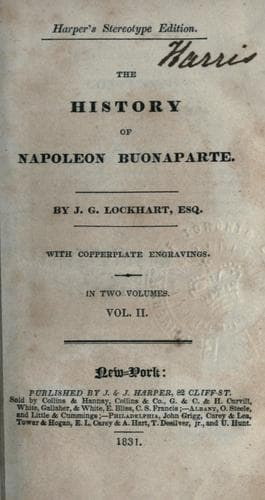
The History of Napoleon BuonaparteLockhart, J. G. (John Gibson)
History
The History of Napoleon Buonaparte
Lockhart, J. G. (John Gibson)
France -- Kings and rulers -- Biography; Napoleon I, Emperor of the French, 1769-1821
Second, the annexation of the Duchy of Oldenburg to the French empire,
by that edict of Napoleon which proclaimed his seizure of the whole
sea-coast of Germany, between Holland and the Baltic. Oldenburg, the
hereditary territory of the Emperor Alexander's brother-in-law, had been
expressly guaranteed to that prince by the treaty of Tilsit. Napoleon
was asked to indemnify the ejected duke by the cession of Dantzick, or
some other territory in the neighbourhood of the Grand Duchy of Warsaw;
but this he declined, though he professed his willingness to give some
compensation elsewhere:
Thirdly, the Czar alleged, and most truly, that the state of his country
made it altogether necessary that the regulations of the "continental
system" should be dispensed with in his instance, and declared that he
could no longer submit to see the commerce of an independent empire
trammelled for the purpose of serving the policy of a foreign power.
Buonaparte admitted that it might be necessary to modify the system
complained of, and expressed his belief that it would be found possible
to devise some middle course, by which the commercial interests of
France and Russia might be reconciled. His meaning probably was, that,
if their other differences could be arranged, this part of the dispute
might be settled by admitting the Czar to adopt, to a certain extent, in
the north of Europe, a device which he himself had already had recourse
to on a large scale, for counteracting the baneful effects of his own
favourite system, in his own immediate territories. Napoleon had soon
discovered that, to exclude English goods and colonial produce entirely,
was actually impossible; and seeing that, either with or without his
assent, the decrees of Berlin and Milan would, in one way or other,
continue to be violated, it occurred to him that he might at least
engross the greater part of the profits of the forbidden traffic
himself. This he accomplished by the establishment of a system of
custom-house regulations, under which persons desirous to import English
produce into France might purchase the imperial licence for so doing. A
very considerable relaxation in the pernicious influence of the Berlin
code was the result of this device; and a proportional increase of the
Emperor's revenue attended it. In after-days, however, he always spoke
of this licence-system as one of the few great mistakes of his
administration. Some petty riots among the manufacturing population of
the county of Derby were magnified in his eyes into symptoms of an
approaching revolution in England; the consequence, as he flattered
himself, of the misery inflicted on his great enemy by the "continental
system"; and to the end he continued to think that, had he resisted the
temptation to enrich his own exchequer by the produce of licences, such
must have been the ultimate issue of his original scheme. It was,
however, by admitting Alexander to a share in the pecuniary advantages
Public-domain text, read in full here on John Shaqi.
Reviews
Reviews
No reviews yet
Be the first to share your thoughts on this work.
Elsewhere in the archive
Join the Discussion
Join the discussion
Sign in to leave a comment or review.
Sign InorCreate an account