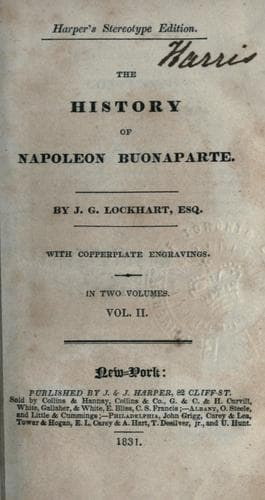
The History of Napoleon BuonaparteLockhart, J. G. (John Gibson)
History
The History of Napoleon Buonaparte
Lockhart, J. G. (John Gibson)
France -- Kings and rulers -- Biography; Napoleon I, Emperor of the French, 1769-1821
When the Emperor of Russia was informed of Buonaparte's approaching
nuptials with the Austrian princess, his first exclamation was, "Then
the next thing will be to drive us back into our forests." In truth the
conferences of Erfurt had but skinned over a wound, which nothing could
have cured but a total alteration of Napoleon's policy. The Russian
nation suffered so much from the "continental system," that the
sovereign soon found himself compelled to relax the decrees drawn up at
Tilsit in the spirit of those of Berlin and Milan. Certain harbours were
opened partially for the admission of colonial produce, and the export
of native productions; and there ensued a series of indignant
reclamations on the part of Napoleon, and haughty evasions on that of
the Czar, which, ere long, satisfied all near observers that Russia
would not be slow to avail herself of any favourable opportunity of once
more appealing to arms. The Spanish insurrection, backed by the
victories of Lord Wellington, must have roused alike the hope and the
pride of a young and ambitious prince, placed at the head of so great a
nation; the inference naturally drawn from Napoleon's marriage into the
house of Austria was, that the whole power of that monarchy would,
henceforth, act in unison with his views--in other words, that were the
Peninsula once thoroughly subdued, the whole of Western Europe would be
at his command, for any service he might please to dictate. It would
have been astonishing if, under such circumstances, the ministers of
Alexander had not desired to bring their disputes with Paris to a close,
before Napoleon should have leisure to consummate the conquest of
Spain.
During the summer of 1811, then, the relations of these two governments
were becoming every day more dubious; and when, towards the close of it,
the Emperor of Austria published a rescript, granting a free passage
through his territories to the troops of his son-in-law, England, ever
watchful of the movements of her great enemy, perceived clearly that she
was about to have an ally.
From the moment in which the Russian government began to reclaim
seriously against certain parts of his conduct, Buonaparte increased by
degrees his military force in the north of Germany and the Grand Duchy
of Warsaw, and advanced considerable bodies of troops nearer and nearer
to the Czar's Polish frontier. These preparations were met by some
similar movements on the other side; yet, during many months, the hope
of terminating the differences by negotiation was not abandoned. The
Russian complaints, at length, assumed a regular shape, and embraced
three distinct heads, viz.:--
First, the extension of the territories of the Duchy of Warsaw, under
the treaty of Schoenbrunn. This alarmed the court of St. Petersburg, by
reviving the notion of Polish independence, and Buonaparte was in vain
urged to give his public guarantee that no national government should be
re-established in the dismembered kingdom:
Public-domain text, read in full here on John Shaqi.
Reviews
Reviews
No reviews yet
Be the first to share your thoughts on this work.
Elsewhere in the archive
Join the Discussion
Join the discussion
Sign in to leave a comment or review.
Sign InorCreate an account