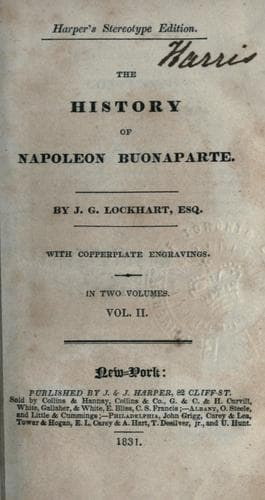
The History of Napoleon BuonaparteLockhart, J. G. (John Gibson)
History
The History of Napoleon Buonaparte
Lockhart, J. G. (John Gibson)
France -- Kings and rulers -- Biography; Napoleon I, Emperor of the French, 1769-1821
Notwithstanding all this display of military strength, the French
statesmen who had in former days possessed the highest place in the
Emperor's confidence, and who had been shaken in his favour by their
bold prophecies of the result of his attempts on Spain and Portugal,
did not hesitate to come forward on this new occasion, and offer
warnings, for which the course of events in the Peninsula might have
been expected to procure a patient hearing. Talleyrand, still in office,
exhausted all his efforts in vain. Fouché, who on pretence of ill health
had thrown up his Roman government, and was now resident at his country
seat near Paris, drew up a memorial, in which the probable consequences
of a march into Russia were detailed with masterly skill and eloquence;
and demanded an audience of the Emperor, that he might present it in
person. Napoleon, whose police now watched no one so closely as their
former chief, was prepared for this. He received Fouché with an air of
cool indifference. "I am no stranger to your errand," said he. "The war
with Russia pleases you as little as that of Spain." Fouché answered,
that he hoped to be pardoned for having drawn up some reflections on so
important a crisis. "It is no crisis at all," resumed Buonaparte, "but a
mere war of politics. Spain falls whenever I have destroyed the English
influence at St. Petersburg. I have 800,000 soldiers in readiness: with
such an army I consider Europe as an old prostitute, who must obey my
pleasure. Did not you yourself once tell me that the word _impossible_
is not French? You grandees are now too rich, and though you pretend to
be anxious about my interests, you are only thinking of what might
happen to yourselves in case of my death, and the dismemberment of my
empire. I regulate my conduct much more by the sentiments of my army
than by yours. Is it my fault that the height of power which I have
attained compels me to ascend to the dictatorship of the world? My
destiny is not yet accomplished-the picture exists as yet only in
outline. There must be one code, one court of appeal, and one coinage
for all Europe. The states of Europe must be melted into one nation, and
Paris be its capital." It deserves to be mentioned that neither the
statesman thus contemptously dismissed, nor any of his brethren, ever
even alluded to the injustice of making war on Russia for the mere
gratification of ambition. Their arguments were all drawn from the
extent of Alexander's resources-his 400,000 regulars, and 50,000
Cossacks, already known to be in arms-and the enormous population on
which he had the means of drawing for recruits; the enthusiastic
national feelings of the Muscovites; the distance of their country; the
severity of their climate; the opportunity which such a war would afford
to England of urging her successes in Spain; and the chance of Germany
rising in insurrection in case of any reverses.
Public-domain text, read in full here on John Shaqi.
Reviews
Reviews
No reviews yet
Be the first to share your thoughts on this work.
Elsewhere in the archive
Join the Discussion
Join the discussion
Sign in to leave a comment or review.
Sign InorCreate an account