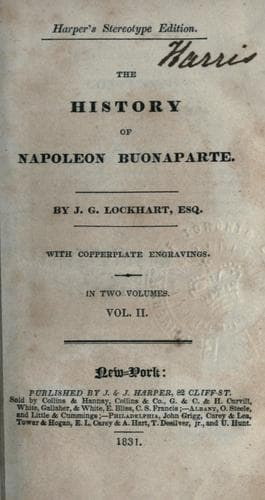
The History of Napoleon BuonaparteLockhart, J. G. (John Gibson)
History
The History of Napoleon Buonaparte
Lockhart, J. G. (John Gibson)
France -- Kings and rulers -- Biography; Napoleon I, Emperor of the French, 1769-1821
There was, however, one person who appealed to the Emperor on other
grounds. His uncle, the Cardinal Fesch, had been greatly afflicted by
the treatment of the Pope, and he contemplated this new war with dread,
as likely to bring down the vengeance of Heaven on the head of one who
had dared to trample on its vicegerent. He besought Napoleon not to
provoke at once the wrath of man and the fury of the elements; and
expressed his belief that he must one day sink under the weight of that
universal hatred with which his actions were surrounding his throne.
Buonaparte led the churchman to the window, opened it, and pointing
upwards, said, "Do you see yonder star?" "No, sire," replied the
Cardinal. "But I see it," answered Napoleon; and abruptly dismissed him.
Trusting to this star, on which one spot of fatal dimness had already
gathered, Napoleon, without waiting for any formal rupture with the
Russian diplomatists at Paris, now directed the march of very great
bodies of troops into Prussia and the Grand Duchy of Warsaw. Alexander's
minister was ordered, in the beginning of April, to demand the
withdrawal of these troops, together with the evacuation of the
fortresses in Pomerania, in case the French government still entertained
a wish to negotiate. Buonaparte instantly replied that he was not
accustomed to regulate the distribution of his forces by the suggestions
of a foreign power. The ambassador demanded his passports, and quitted
Paris.
On the 9th of May, Napoleon left Paris with his Empress, and arrived on
the 16th at Dresden, where the Emperor of Austria, the Kings of Prussia,
Naples, Wirtemberg, and Westphalia, and almost every German sovereign of
inferior rank, had been invited, or commanded, to met him. He had sent
to request the Czar also to appear in this brilliant assemblage, as
affording a last chance of an amicable arrangement; but the messenger
could not obtain admission to Alexander's presence.
Buonaparte continued for some days to play the part of undisputed master
amidst this congregation of royalties. He at once assumed for himself
and his wife precedence over the Emperor and Empress of Austria; and, in
the blaze of successive festivals, the King of Saxony appeared but as
some chamberlain, or master of the ceremonies, to his imperious guest.
Public-domain text, read in full here on John Shaqi.
Reviews
Reviews
No reviews yet
Be the first to share your thoughts on this work.
Elsewhere in the archive
Join the Discussion
Join the discussion
Sign in to leave a comment or review.
Sign InorCreate an account