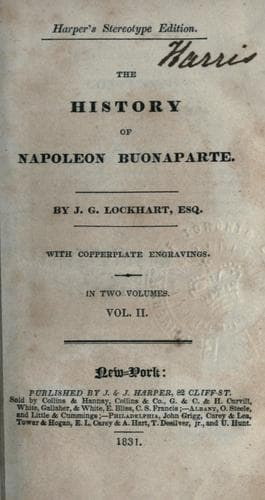
The History of Napoleon BuonaparteLockhart, J. G. (John Gibson)
History
The History of Napoleon Buonaparte
Lockhart, J. G. (John Gibson)
France -- Kings and rulers -- Biography; Napoleon I, Emperor of the French, 1769-1821
Having sufficiently indicated to his allies and vassals the conduct
which they were respectively to adopt, in case the war should break out,
Napoleon, already weary of his splendid idleness, sent on the Abbé de
Pradt to Warsaw, to prepare for his reception among the Poles, dismissed
Maria Louisa on her return to Paris, and broke up the Court in which he
had, for the last time, figured as "the King of Kings." Marshal Ney,
with one great division of the army, had already passed the Vistula;
Junot, with another, occupied both sides of the Oder. The Czar was known
to be at Wilna, his Lithuanian capital, there collecting the forces of
his immense empire, and entrusting the general arrangements of the
approaching campaign to Marshal Barclay de Tolly.[61] The season was
advancing; and it was time that the question of peace or war should be
forced to a decision.
Napoleon arrived at Dantzick on the 7th of June; and during the
fortnight which ensued, it was known that the final communications
between him and Alexander were taking place. The attention of mankind
was never more entirely fixed on one spot than it was, during these
fourteen days, upon Dantzick. On the 22nd, Buonaparte broke silence in a
bulletin. "Soldiers," said he, "Russia is dragged on by her fate: her
destiny must be accomplished. Let us march! let us cross the Niemen: let
us carry war into her territories. Our second campaign of Poland will be
as glorious as our first: but our second peace shall carry with it its
own guarantee: it shall put an end for ever to that haughty influence
which Russia has exercised for fifty years on the affairs of Europe."
The address, in which the Czar announced the termination of his
negotiations, was in a far different tone. After stating the innumerable
efforts he had made to preserve peace, without losing for Russia the
character of an independent state, he invoked the aid of Almighty
Providence as "the witness and the defender of the true cause;" and
concluded in these words--"Soldiers, you fight for your religion, your
liberty, and your native land. Your Emperor is amongst you; and God is
the enemy of the aggressor."
Public-domain text, read in full here on John Shaqi.
Reviews
Reviews
No reviews yet
Be the first to share your thoughts on this work.
Elsewhere in the archive
Join the Discussion
Join the discussion
Sign in to leave a comment or review.
Sign InorCreate an account