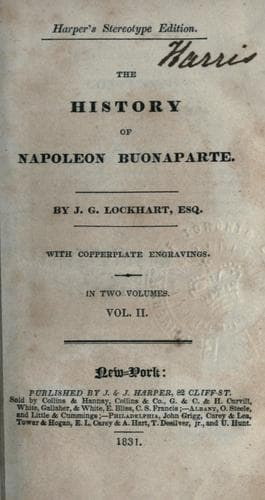
The History of Napoleon BuonaparteLockhart, J. G. (John Gibson)
History
The History of Napoleon Buonaparte
Lockhart, J. G. (John Gibson)
France -- Kings and rulers -- Biography; Napoleon I, Emperor of the French, 1769-1821
It was noticed in an early part of this narrative that Napoleon's plan
of warfare could hardly have been carried into execution on a great
scale, unless by permitting the troops to subsist on plunder; and we
have seen through how many campaigns the marauding system was adopted
without producing any serious inconvenience to the French. Buonaparte,
however, had learned from Spain and Portugal how difficult it is for
soldiers to find food in these ways, provided the population around them
be really united in hostility against them. He had further considered
the vast distance at which a war with Russia must needs be carried on,
and the natural poverty of most of the Czar's provinces, and came to the
resolution of departing on this occasion from his old system. In a word,
months before he left Paris, he had given orders for preparing immense
quantities of provisions of all kinds, to be conveyed along with his
gigantic host, and render him independent of the countries which might
form the theatre of his operations. The destruction of the magazines at
Wilna was sufficient indication that the Emperor had judged well in
ordering his commissariat to be placed on an efficient footing; and his
attention was naturally directed to ascertaining, ere he advanced
further, in how much his directions as to this matter had been
fulfilled. He remained twenty days at Wilna--a pause altogether
extraordinary in a Buonapartean campaign, and which can only be
accounted for by his anxiety on this head. The result of his inquiries
was most unsatisfactory. The prodigious extent of the contracts into
which his war-minister had entered was adequate to the occasion; but the
movement of such enormous trains of cattle and waggons as these
contracts provided for must, under any circumstances, have been tedious,
and in some degree uncertain. In this case they were entered into either
by French traders, who, in consequence of Buonaparte's own practice in
preceding campaigns, could have slender experience of the method of
supplying a great army in the field; by Germans, who regarded the French
Emperor as the enemy of the world, and served him accordingly with
reluctance; or finally, by Polish Jews--a race of inveterate smugglers,
and consequently of inveterate swindlers.
The result was, that after spending three weeks at Wilna, the Emperor
found himself under the necessity, either of laying aside his invasion
for another year, or of urging it in the face of every difficulty which
he had foreseen, and, moreover, of that presented by a commissariat less
effective by two-thirds than he had calculated on.
[Footnote 61: This officer had been born and educated in Germany. He was
descended from an ancient Scottish family, exiled for adherence to the
Stuarts, in 1715.]
CHAPTER XXX
Public-domain text, read in full here on John Shaqi.
Reviews
Reviews
No reviews yet
Be the first to share your thoughts on this work.
Elsewhere in the archive
Join the Discussion
Join the discussion
Sign in to leave a comment or review.
Sign InorCreate an account