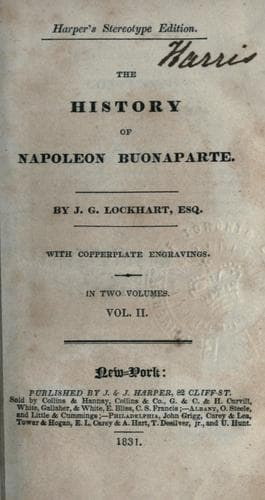
The History of Napoleon BuonaparteLockhart, J. G. (John Gibson)
History
The History of Napoleon Buonaparte
Lockhart, J. G. (John Gibson)
France -- Kings and rulers -- Biography; Napoleon I, Emperor of the French, 1769-1821
Russia makes Peace with England, with Sweden, and with
Turkey--Internal preparations--Napoleon leaves Wilna--The
Dwina--Bagrathion's Movements--Battle of Smolensko--Battle of
Borodino--Napoleon enters Moscow--Constancy and Enthusiasm of the
Russians--Conduct of Rostophchin--The burning of Moscow--Kutusoff
refuses to Treat.
While Napoleon was detained in the capital of Lithuania by the confusion
and slowness which marked almost every department of his commissariat at
this great crisis, the enemy employed the unexpected pause to the best
advantage. The Czar signed treaties of strict alliance with England,
Sweden, and the Spanish Cortes, in the middle of July; and the
negotiation with Turkey was urged, under the mediation of England, so
effectually, that a peace with that Power also was proclaimed early in
August. By these means Alexander was enabled to withdraw whatever troops
he had been maintaining on the two flanks of his European dominions, and
bring them all to the assistance of his main army. Admiral Tchichagoff,
at the head of 50,000 soldiers, hitherto opposed to the Turks on the
side of Moldavia, marched towards the left wing of Barclay de Tolly's
force; and the right, which had gradually retired until it reached a
strong camp formed on the river Dwina, was reinforced from Finland,
though not so largely. The enthusiasm of the Russian nation appeared in
the extraordinary rapidity with which supplies of every kind were poured
at the feet of the Czar. From every quarter he received voluntary offers
of men, of money, of whatever might assist in the prosecution of the
war. The Grand Duchess, whose hand Napoleon had solicited, set the
example by raising a regiment on her estate. Moscow offered to equip and
arm 80,000 men. Platoff, the veteran hetman of the Cossacks, promised
his only daughter and 200,000 roubles to the man by whose hand
Buonaparte should fall. Noblemen everywhere raised troops, and displayed
their patriotism by serving in the ranks themselves, and entrusting the
command to experienced officers, chosen by the government. The
peasantry participated in the general enthusiasm, and flocked in from
every province, demanding arms and training. Two hundred thousand
militiamen were called out, and in separate divisions began their march
upon the camp.
Public-domain text, read in full here on John Shaqi.
Reviews
Reviews
No reviews yet
Be the first to share your thoughts on this work.
Elsewhere in the archive
Join the Discussion
Join the discussion
Sign in to leave a comment or review.
Sign InorCreate an account