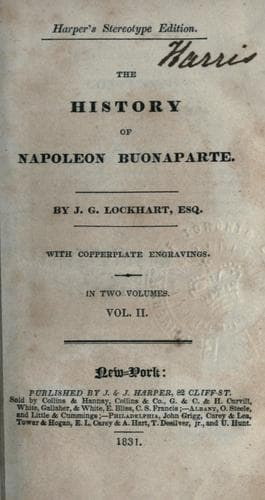
The History of Napoleon BuonaparteLockhart, J. G. (John Gibson)
History
The History of Napoleon Buonaparte
Lockhart, J. G. (John Gibson)
France -- Kings and rulers -- Biography; Napoleon I, Emperor of the French, 1769-1821
Buonaparte had not gazed long on this great capital ere it struck him as
something remarkable that no smoke issued from the chimneys. Neither
appeared there any military on the battlements of the old walls and
towers. There reached him neither message of defiance, nor any
deputation of citizens to present the keys of their town, and recommend
it and themselves to his protection. He was yet marvelling what these
strange circumstances could mean, when Murat, who commanded in the van,
and had pushed on to the gates, came back and informed him that he had
held a parley with Milarodowitch, the general of the Russian rear-guard,
and that, unless two hours were granted for the safe withdrawing of his
troops, he would at once set fire to Moscow. Napoleon immediately
granted the armistice. The two hours elapsed, and still no procession of
nobles or magistrates made its appearance.
On entering the city the French found it deserted by all but the very
lowest and most wretched of its vast population. They soon spread
themselves over its innumerable streets, and commenced the work of
pillage. The magnificent palaces of the Russian boyards, the bazaars of
the merchants, churches and convents, and public buildings of every
description, swarmed with their numbers.
The meanest soldier clothed himself in silk and furs, and drank at his
pleasure the costliest wines. Napoleon, perplexed at the abandonment of
so great a city, had some difficulty in keeping together 30,000 men
under Murat, who followed Milarodowitch, and watched the walls on that
side.
The Emperor, who had retired to rest in a suburban palace, was awakened
at midnight by the cry of _fire_. The chief market-place was in flames;
and some hours elapsed before they could be extinguished by the
exertions of the soldiery. While the fire still blazed, Napoleon
established his quarters in the Kremlin, and wrote, by that fatal light,
a letter to the Czar, containing proposals for peace. The letter was
committed to a prisoner of rank; no answer ever reached Buonaparte.
Next morning found the fire extinguished, and the French officers were
busied throughout the day in selecting houses for their residence. The
flames, however, burst out again as night set in, and under
circumstances which might well fill the mind of the invaders with
astonishment and with alarm. Various detached parts of the city appeared
to be at once on fire; combustibles and matches were discovered in
different places as laid deliberately; the water-pipes were cut: the
wind changed three times in the course of the night, and the flames
always broke out again with new vigour in the quarter from which the
prevailing breeze blew right on the Kremlin. It was sufficiently plain
that Rostophchin, governor of Moscow, had adopted the same plan of
resistance in which Smolensko had already been sacrificed; and his
agents, whenever they fell into the hands of the French, were massacred
without mercy.
Public-domain text, read in full here on John Shaqi.
Reviews
Reviews
No reviews yet
Be the first to share your thoughts on this work.
Elsewhere in the archive
Join the Discussion
Join the discussion
Sign in to leave a comment or review.
Sign InorCreate an account