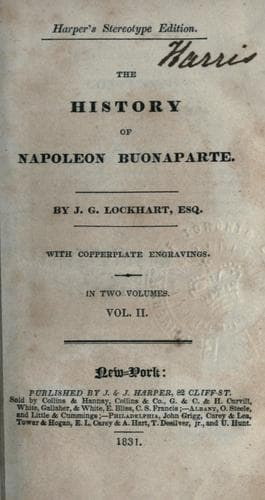
The History of Napoleon BuonaparteLockhart, J. G. (John Gibson)
History
The History of Napoleon Buonaparte
Lockhart, J. G. (John Gibson)
France -- Kings and rulers -- Biography; Napoleon I, Emperor of the French, 1769-1821
Buonaparte, when advised by his generals, towards the conclusion of the
day, to bring forward his own guard and hazard one final attack at their
head, answered, "And if my guard fail, what means should I have for
renewing the battle to-morrow?" The Russian commander, on the other
hand, appears to have spared nothing to prolong the contest.--During the
night after, his cavalry made several attempts to break into the enemy's
lines; and it was only on receiving the reports of his regimental
officers in the morning, that Kutusoff perceived the necessity of
retiring until he should be further recruited. His army was the mainstay
of his country: on its utter dissolution his master might have found it
very difficult to form another; but while it remained perfect in its
organisation, the patriotic population of the empire were sure to fill
up readily every vacancy in its ranks. Having ascertained then the
extent of his loss, and buried his dead (among whom was the gallant
Bagrathion) with great solemnity,--the Russian slowly and calmly
withdrew from his intrenchments, and marched on Mojaisk. Napoleon was so
fortunate as to be joined exactly at this time by two fresh divisions
from Smolensko, which nearly restored his muster to what it had been
when the battle began; and, thus reinforced, commanded the pursuit to
be vigorously urged. On the 9th, the French van came in sight of the
Russian rear again, and Buonaparte prepared for battle. But next morning
Kutusoff had masked his march so effectually, by scattering clouds of
Cossacks in every direction around the French, that down to the 12th the
invader remained uncertain whether he had retreated on Kalouga, or
directly to the capital. The latter he, at length, found to be the case;
and on the 14th of September Napoleon reached the Hill of Salvation; so
named because from that eminence the Russian traveller obtains his first
view of the ancient metropolis, affectionately called "Mother Moscow,"
and hardly less sacred in his eyes than Jerusalem. The soldiery beheld
with joy and exultation the magnificent extent of the place; its mixture
of Gothic steeples and Oriental domes; the vast and splendid mansions of
the haughty boyards, embosomed in trees; and, high over all the rest,
the huge towers of the Kremlin, at once the palace and the citadel of
the old Czars. The cry of "Moscow! Moscow!" ran through the lines.
Napoleon himself reined in his horse and exclaimed, "Behold at last that
celebrated city!" He added, after a brief pause, "it was time."
Public-domain text, read in full here on John Shaqi.
Reviews
Reviews
No reviews yet
Be the first to share your thoughts on this work.
Elsewhere in the archive
Join the Discussion
Join the discussion
Sign in to leave a comment or review.
Sign InorCreate an account