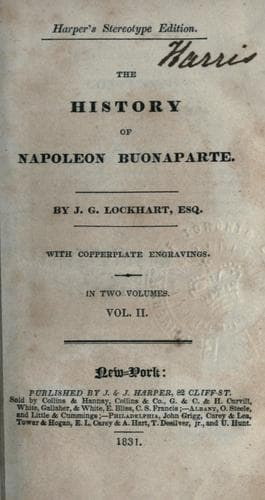
The History of Napoleon BuonaparteLockhart, J. G. (John Gibson)
History
The History of Napoleon Buonaparte
Lockhart, J. G. (John Gibson)
France -- Kings and rulers -- Biography; Napoleon I, Emperor of the French, 1769-1821
There is reason to believe that the levity and haughtiness with which
some of the young French gentlemen at this seminary conducted themselves
towards this poor, solitary alien, had a strong effect on the first
political feelings of the future Emperor of France. He particularly
resented their jokes about his foreign name _Napoleon_. Bourienne says
he often told him--"Hereafter I will do the French what harm I can; as
for you, you never make me your jest--you love me."
From the beginning of the revolutionary struggle, boy and youth, he
espoused and kept by the side of those who desired the total change of
government. It is a strange enough fact, that Pichegru, afterwards so
eminent and ultimately so unfortunate, was for some time his monitor in
the school of Brienne. Being consulted many years later as to the chance
of enlisting Buonaparte in the cause of the exiled Bourbons, this man is
known to have answered: "It will be lost time to attempt that--I knew
him in his youth--he has taken his side, and he will not change it."
In 1783 Buonaparte was, on the recommendation of his masters, sent from
Brienne to the Royal Military School at Paris; this being an
extraordinary compliment to the genius and proficiency of a boy of
fifteen.[5] Here he spent nearly two years, devoted to his studies. That
he laboured hard, both at Brienne and at Paris, we may judge; for his
after-life left scanty room for book-work, and of the vast quantity of
information which his strong memory ever placed at his disposal, the far
greater proportion must have been accumulated now. He made himself a
first-rate mathematician; he devoured history--his chosen authors being
Plutarch and Tacitus; the former the most simple painter that antiquity
has left us of heroic characters--the latter the profoundest master of
political wisdom. The poems of Ossian were then new to Europe, and
generally received as authentic remains of another age and style of
heroism. The dark and lofty genius which they display, their indistinct
but solemn pictures of heroic passions, love, battle, victory, and
death, were appropriate food for Napoleon's young imagination; and, his
taste being little scrupulous as to minor particulars, Ossian continued
to be through life his favourite poet. While at Paris, he attracted much
notice among those who had access to compare him with his fellows; his
acquirements, among other advantages, introduced him to the familiar
society of the celebrated Abbé Raynal. Napoleon, shortly after entering
the school at Paris, drew up a memorial, which he in person presented to
the superintendents of the establishment. He complained that the mode of
life was too expensive and delicate for "poor gentlemen," and could not
prepare them either for returning to their "modest homes," or for the
hardships of the camp. He proposed that, instead of a regular dinner of
two courses daily, the students should have ammunition bread, and
Public-domain text, read in full here on John Shaqi.
Reviews
Reviews
No reviews yet
Be the first to share your thoughts on this work.
Join the Discussion
Join the discussion
Sign in to leave a comment or review.
Sign InorCreate an account