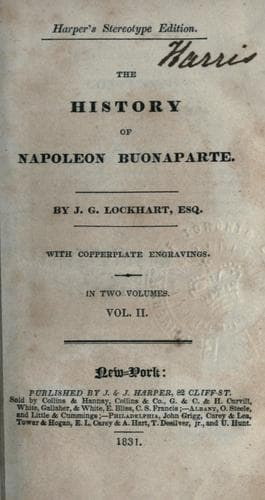
The History of Napoleon BuonaparteLockhart, J. G. (John Gibson)
History
The History of Napoleon Buonaparte
Lockhart, J. G. (John Gibson)
France -- Kings and rulers -- Biography; Napoleon I, Emperor of the French, 1769-1821
The final settlement with the emperor's commissioners would have taken
place shortly after the fall of Venice, but for the successful intrigues
of the royalist Clichyens, the universal belief that the government of
France approached some new crisis, and the Austrians' hope that from
such an event their negotiation might derive considerable advantages.
Buonaparte well knew the secret motive which induced Cobentzel, the
emperor's chief envoy, to protract and multiply discussions of which he
by this time was weary. One day, in this ambassador's own chamber,
Napoleon suddenly changed his demeanour; "you refuse to accept our
ultimatum," said he, taking in his hands a beautiful vase of porcelain,
which stood on the mantelpiece near him. The Austrian bowed. "It is
well," said Napoleon, "but mark me--within two months I will shatter
Austria like this potsherd." So saying, he dashed the vase on the ground
in a thousand pieces, and moved towards the door. Cobentzel followed
him, and made submissions which induced him once more to resume his
negotiations.
The result was the treaty of Campo-Formio, so-called from the village at
which it was signed, on the 3d of October, 1797. By this act the emperor
yielded to France, Flanders and the boundary of the Rhine, including the
great fortress of Mentz. The various new republics of Lombardy were
united and recognised under the general name of the Cisalpine Republic.
To indemnify Austria for the loss of those territories, the fall of
Venice afforded new means--of which Napoleon did not hesitate to
propose, nor Austria to accept the use. The French general had indeed
conquered Venice, but he had entered into a treaty subsequently, and
recognised a wholly new government in place of the oligarchy. The
emperor, on the other hand, well knew that the Doge and Senate had
incurred ruin by rising to his own aid. Such considerations weighed
little on either side. France and Austria agreed to effect a division of
the whole territories of the ancient republic. Venice herself, and her
Italian provinces, were handed over to the emperor in lieu of his lost
Lombardy; and the French assumed the sovereignty of the Ionian islands
and Dalmatia. This unprincipled proceeding excited universal disgust
throughout Europe. It showed the sincerity of Buonaparte's love for the
cause of freedom; and it satisfied all the world of the excellent title
of the imperial court to complain of the selfishness and rapacity of the
French democracy.
Public-domain text, read in full here on John Shaqi.
Reviews
Reviews
No reviews yet
Be the first to share your thoughts on this work.
Elsewhere in the archive
Join the Discussion
Join the discussion
Sign in to leave a comment or review.
Sign InorCreate an account