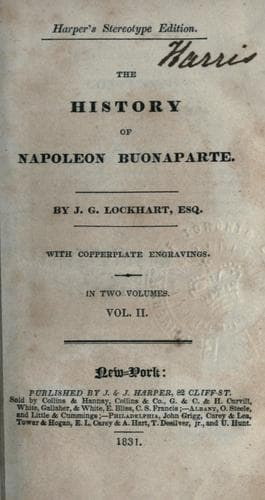
The History of Napoleon BuonaparteLockhart, J. G. (John Gibson)
History
The History of Napoleon Buonaparte
Lockhart, J. G. (John Gibson)
France -- Kings and rulers -- Biography; Napoleon I, Emperor of the French, 1769-1821
The emperor set his seal at Campo-Formio to another of Buonaparte's acts
of dictatorship, which, though in one point of view even more
unjustifiable than this, was not regarded by the world with feelings of
the same order. The Italian territory of the Valteline had for ages been
subject to the Grison League. The inhabitants, roused by the prevailing
spirit all around them, demanded Napoleon's intercession with their
Swiss masters, to procure their admission to all the political
privileges of the other cantons. They refused; and Napoleon, in the
plenitude of his authority, immediately supported the Valteline in
throwing off the Grison yoke, and asserting its utter independence. This
territory was now annexed to the Cisalpine Republic. A government, with
which France was on terms of alliance and amity, was thus robbed of its
richest possession; but the Valteline belonged by natural position,
religion, and language, to Italy, and its annexation to the new Italian
republic was regarded as in itself just and proper, however questionable
Buonaparte's title to effect that event. He himself said at the time,
"It is contrary to the rights of man that any one people should be
subject to another;" a canon on which his after history formed a lucid
commentary.
In concluding, and in celebrating the conclusion of his treaty,
Napoleon's proud and fiery temperament twice shone out. Cobentzel had
set down as the first article, "The Emperor recognises the French
Republic." "Efface that," said Napoleon, sternly, "it is as clear as
that the sun is in heaven. Woe to them that cannot distinguish the light
of either!" At the TE DEUM after the proclamation of the peace,
the imperial envoy would have taken the place prepared for Buonaparte,
which was the most eminent in the church. The haughty soldier seized his
arm and drew him back. "Had your master himself been here," said he, "I
should not have forgotten that in my person the dignity of France is
represented."
Public-domain text, read in full here on John Shaqi.
Reviews
Reviews
No reviews yet
Be the first to share your thoughts on this work.
Elsewhere in the archive
Join the Discussion
Join the discussion
Sign in to leave a comment or review.
Sign InorCreate an account