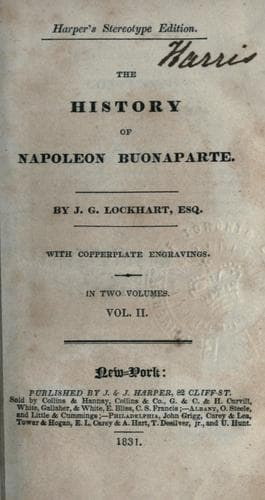
The History of Napoleon BuonaparteLockhart, J. G. (John Gibson)
History
The History of Napoleon Buonaparte
Lockhart, J. G. (John Gibson)
France -- Kings and rulers -- Biography; Napoleon I, Emperor of the French, 1769-1821
For some days no enemy appeared; but at length scattered groups of
horsemen began to hover on their flanks; and the soldier, who quitted
the line but for a moment, was surrounded and put to death ere his
comrades could rescue him. The rapidity with which the Mamelukes rode,
and their skill as marksmen, were seconded by the character of the soil
and the atmosphere; the least motion or breath of wind being sufficient
to raise a cloud of sand, through which nothing could be discerned
accurately, while the constant glare of the sun dazzled almost to
blindness. It was at Chebreis that the Mamelukes first attacked in a
considerable body; and at the same moment the French flotilla was
assaulted. In either case the superiority of European discipline was
made manifest; but in either case also the assailants were able to
retreat without much loss. Meantime the hardships of the march
continued; the irregular attacks of the enemy were becoming more and
more numerous; so that the troops, continually halting and forming into
squares to receive the charge of the cavalry by day, and forced to keep
up great watches at night, experienced the extremes of fatigue as well
as of privation. In the midst of this misery the common men beheld with
no friendly eyes the troop of _savans_ mounted on asses (the common
conveyance of the country), with all their instruments, books and
baggage. They began to suspect that the expedition had been undertaken
for some merely scientific purposes; and when, on any alarm, they were
ordered to open the square and give the learned party safe footing
within, they used to receive them with military jeerings. "Room for the
asses:--stand back, here come the _savans_ and the _demi-savans_."
On the 21st of July the army came within sight of the Pyramids, which,
but for the regularity of the outline, might have been taken for a
distant ridge of rocky mountains. While every eye was fixed on these
hoary monuments of the past, they gained the brow of a gentle eminence,
and saw at length spread out before them the vast army of the beys, its
right posted on an entrenched camp by the Nile, its centre and left
composed of that brilliant cavalry with which they were by this time
acquainted. Napoleon, riding forwards to reconnoitre, perceived (what
escaped the observation of all his staff) that the guns on the
entrenched camp were not provided with carriages; and instantly decided
on his plan of attack. He prepared to throw his force on the left, where
the guns could not be available. Mourad Bey, who commanded in chief,
speedily penetrated his design; and the Mamelukes advanced gallantly to
the encounter. "Soldiers," said Napoleon, "from the summit of yonder
pyramids forty ages behold you;" and the battle began.
Public-domain text, read in full here on John Shaqi.
Reviews
Reviews
No reviews yet
Be the first to share your thoughts on this work.
Elsewhere in the archive
Join the Discussion
Join the discussion
Sign in to leave a comment or review.
Sign InorCreate an account