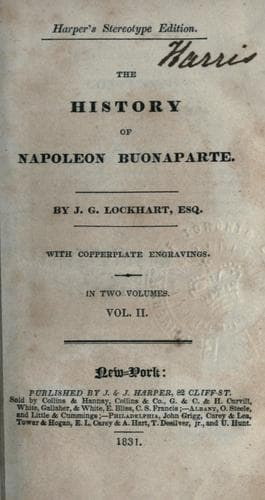
The History of Napoleon BuonaparteLockhart, J. G. (John Gibson)
History
The History of Napoleon Buonaparte
Lockhart, J. G. (John Gibson)
France -- Kings and rulers -- Biography; Napoleon I, Emperor of the French, 1769-1821
Buonaparte was a fatalist--so that one main article of the Mussulman
creed pleased him well. He admired Mahomet as one of those rare beings,
who, by individual genius and daring, have produced mighty and permanent
alterations in the world. The General's assertion of his own belief in
the inspiration of the Arab impostor, was often repeated in the sequel;
and will ever be appreciated, as it was at the time by his own
soldiery--whom indeed he had addressed but the day before in language
sufficiently expressive of his real sentiments as to all forms of
religion. Rabbi, muphti, and bishop, the Talmud, the Koran, and the
Bible, were much on a level in his estimation. He was willing to make
use of them all as it might serve his purpose; and, though not by nature
cruel, he did not hesitate, when his interest seemed to demand it, to
invest his name with every circumstance of terror, that could result
from the most merciless violation of those laws of humanity which even
his Koran enforces, and which his own address to his army had so
recently inculcated.
Napoleon left Alexandria on the 7th July, being anxious to force the
Mamelukes to an encounter with the least possible delay. He had a small
flotilla on the Nile, which served to guard his right flank: the
infantry marched over burning sand at some distance from the river. The
miseries of this progress were extreme. The air is crowded with
pestiferous insects, the glare of the sand weakens most men's eyes, and
blinds many; water is scarce and bad: and the country had been swept
clear of man, beast, and vegetable. Under this torture even the gallant
spirits of such men as Murat and Lannes could not sustain
themselves:--they trod their cockades in the sand. The common soldiers
asked, with angry murmurs, if it was here the General designed to give
them their seven acres? He alone was superior to all these evils. Such
was the happy temperament of his frame, that--while others, after having
rid them of their usual dress, were still suffused in perpetual floods
of perspiration, and the hardiest found it necessary to give two or
three hours in the middle of the day to sleep--Napoleon altered
nothing; wore his uniform buttoned up as at Paris; never showed one bead
of sweat on his brow; nor thought of repose except to lie down in his
cloak the last at night, and start up the first in the morning. It
required, however, more than all his example of endurance and the
general influence of Napoleon's character, could do to prevent the army
from breaking into open mutiny. "Once," said he at St. Helena, "I threw
myself suddenly amidst a group of _generals_, and, addressing myself to
the tallest of their number with vehemence, said, _You have been talking
sedition: take care lest I fulfil my duty: your five feet ten inches
would not hinder you from being shot within two hours._"
Public-domain text, read in full here on John Shaqi.
Reviews
Reviews
No reviews yet
Be the first to share your thoughts on this work.
Elsewhere in the archive
Join the Discussion
Join the discussion
Sign in to leave a comment or review.
Sign InorCreate an account