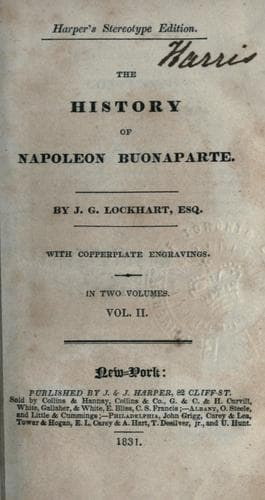
The History of Napoleon BuonaparteLockhart, J. G. (John Gibson)
History
The History of Napoleon Buonaparte
Lockhart, J. G. (John Gibson)
France -- Kings and rulers -- Biography; Napoleon I, Emperor of the French, 1769-1821
He was careful to advance no claim to the sovereignty of Egypt, but
asserted, that having rescued it from the Mameluke _usurpation_, it
remained for him to administer law and justice, until the time should
come for restoring the province to the dominion of the Grand Seignior.
He then established two councils, consisting of natives, principally of
Arab chiefs and Moslem of the church and the law, by whose advice all
measures were, nominally, to be regulated. They formed of course a very
subservient senate. He had no occasion to demand more from the people
than they had been used to pay to the beys; and he lightened the impost
by introducing as far as he could the fairness and exactness of a
civilised power in the method of levying it. He laboured to make the
laws respected, and this so earnestly and rigidly, that no small wonder
was excited among all classes of a population so long accustomed to the
licence of a barbarian horde of spoilers. On one occasion one of the
Ulemahs could not help smiling at the zeal which he manifested for
tracing home the murder of an obscure peasant to the perpetrator. The
Mussulman asked if the dead man were anywise related to the blood of the
Sultan Kebir? "No," answered Napoleon, sternly--"but he was more than
that--he was one of a people whose government it has pleased Providence
to place in my hands." The measures which he took for the protection of
travellers to Mecca were especially acceptable to the heads of the
Moslem establishment, and produced from them a proclamation, (in direct
contradiction to the Koran,) signifying that it was right and lawful to
pay tribute to the French. The virtuosi and artists in his train,
meanwhile, pursued with indefatigable energy their scientific
researches; they ransacked the monuments of Egypt, and laid the
foundation, at least, of all the wonderful discoveries, which have since
been made concerning the knowledge, arts, polity (and even language) of
the ancient nation. Nor were their objects merely those of curiosity.
They, under the General's direction, examined into the long-smothered
traces of many an ancient device for improving the agriculture of the
country. Canals that had been shut up for centuries were re-opened: the
waters of the Nile flowed once more where they had been guided by the
skill of the Pharaohs or the Ptolemies. Cultivation was extended;
property secured; and it cannot be doubted that the signal improvements
since introduced in Egypt, are attributable mainly to the wise example
of the French administration. At Cairo itself there occurred one stormy
insurrection, provoked, as may be supposed, by some wantonness on the
part of the garrison; but, after this was quelled by the same merciless
vigour which Napoleon had displayed on similar occasions in Italy, the
country appears to have remained in more quiet, and probably enjoyed, in
spite of the presence of an invading army, more prosperity, than it had
Public-domain text, read in full here on John Shaqi.
Reviews
Reviews
No reviews yet
Be the first to share your thoughts on this work.
Elsewhere in the archive
Join the Discussion
Join the discussion
Sign in to leave a comment or review.
Sign InorCreate an account