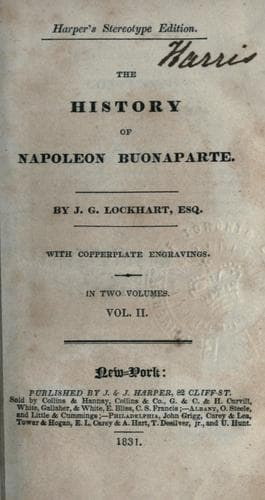
The History of Napoleon BuonaparteLockhart, J. G. (John Gibson)
History
The History of Napoleon Buonaparte
Lockhart, J. G. (John Gibson)
France -- Kings and rulers -- Biography; Napoleon I, Emperor of the French, 1769-1821
ever done during any period of the same length, since the Saracen
government was overthrown by the Ottomans.
In such labours Napoleon passed the autumn of 1798. "At this period,"
writes his secretary, "it was his custom to retire early to bed, and it
was my business to read to him as long as he remained awake. If I read
poetry, he soon fell asleep, but if, as sometimes happened, he called
for _The Life of Cromwell_, I made up mind to want repose for that
night."
General Dessaix, meanwhile, had pursued Mourad Bey into Upper Egypt,
where the Mamelukes hardly made a single stand against him, but
contrived, by the excellence of their horses, and their familiarity with
the deserts, to avoid any total disruption of their forces. Mourad
returned to the neighbourhood of Cairo on hearing of the insurrection
already mentioned; but departed when he learned its suppression. Those
gallant horsemen were gradually losing numbers in their constant desert
marches--they were losing heart rapidly: and everything seemed to
promise, that the Upper Egypt, like the Lower, would soon settle into a
peaceful province of the new French colony.
The General, during this interval of repose, received no communication
from the French government; but rumours now began to reach his quarters
which might well give him new anxieties. The report of another rupture
with Austria gradually met with more credence; and it was before long
placed beyond a doubt, that the Ottoman Porte, instead of being tempted
into any recognition of the French establishment in Egypt, had declared
war against the Republic, and summoned all the strength of her empire
to pour in overwhelming numbers on the isolated army of Buonaparte.
As yet, however, there was no appearance of an enemy; and Napoleon
seized the opportunity to explore the Isthmus of Suez, where a narrow
neck of land divides the Red Sea from the Mediterranean, partly with the
view of restoring the communication which in remote times existed
between them, and partly of providing for the defence of Egypt, should
the Ottomans attempt their invasion by the way of Syria.
Public-domain text, read in full here on John Shaqi.
Reviews
Reviews
No reviews yet
Be the first to share your thoughts on this work.
Elsewhere in the archive
Join the Discussion
Join the discussion
Sign in to leave a comment or review.
Sign InorCreate an account