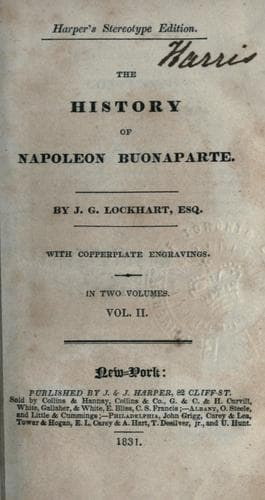
The History of Napoleon BuonaparteLockhart, J. G. (John Gibson)
History
The History of Napoleon Buonaparte
Lockhart, J. G. (John Gibson)
France -- Kings and rulers -- Biography; Napoleon I, Emperor of the French, 1769-1821
The accusation, which for many years made so much noise throughout
Europe, amounts to this: that on the 27th of May, when it was necessary
for Napoleon to pursue his march from Jaffa for Egypt, a certain number
of the plague-patients in the hospital were found to be in a state that
held out no hope whatever of their recovery; that the general, being
unwilling to leave them to the tender mercies of the Turks, conceived
the notion of administering opium, and so procuring for them at least a
speedy and an easy death; and that a number of men were accordingly
taken off in this method by his command. The story, the circumstances of
which were much varied in different accounts, especially as regards the
numbers of the poisoned (raised sometimes as high as 500), was first
disseminated by Sir Robert Wilson, and was in substance generally
believed in England. In each and all of its parts, on the contrary, it
was wholly denied by the admirers of Buonaparte, who treated it as one
of the many gross falsehoods, which certainly were circulated touching
the personal character and conduct of their idol, during the continuance
of his power.
Buonaparte himself, while at St. Helena, referred to the story
frequently; and never hesitated to admit that it originated in the
following occurrence. He sent, he said, the night before the march was
to commerce, for Desgenettes, the chief of the medical staff, and
proposed to him, under such circumstances as have been described, the
propriety of giving opium, in mortal doses, to _seven_ men, adding that,
had his son been in their situation, he would have thought it his duty,
as a father, to treat him in the same method; and that, most certainly,
had he himself been in that situation, and capable of understanding it,
he would have considered the deadly cup as the best boon that friendship
could offer him. M. Desgenettes, however, (said the ex-Emperor) did not
consider himself as entitled to interfere in any such method with the
lives of his fellow men: the patients were abandoned; and, at least, one
of the number fell alive into the hands of Sir Sidney Smith, and
recovered.
Such is Napoleon's narrative; and it is confirmed in all particulars of
importance, save _two_, by De Bourienne. That writer states distinctly
that he was present when Napoleon, Berthier and the usual suite,
examined the hospital--heard the discussion which followed, and _the
order given_ for administering mortal potions to the hopeless
patients--in number _sixty_. He does not assert that he saw the poison
administered, but says he has no doubt the order was executed; and
concludes with defending the measure by arguments similar to those
already quoted from the lips of his master.
Public-domain text, read in full here on John Shaqi.
Reviews
Reviews
No reviews yet
Be the first to share your thoughts on this work.
Elsewhere in the archive
Join the Discussion
Join the discussion
Sign in to leave a comment or review.
Sign InorCreate an account