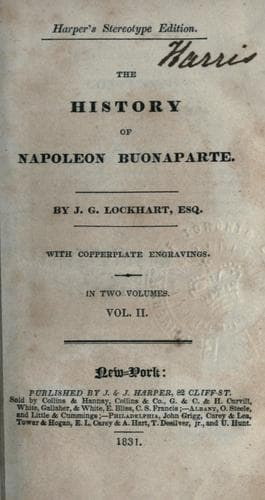
The History of Napoleon BuonaparteLockhart, J. G. (John Gibson)
History
The History of Napoleon Buonaparte
Lockhart, J. G. (John Gibson)
France -- Kings and rulers -- Biography; Napoleon I, Emperor of the French, 1769-1821
Whether the opium was really administered or not--that the audacious
proposal to that effect was made by Napoleon, we have his own admission;
and every reader must form his opinion--as to the degree of guilt which
attaches to the fact of having meditated and designed the deed in
question, under the circumstances above detailed. That Buonaparte,
accustomed to witness slaughter in every form, was in general but a
callous calculator when the loss of human life was to be considered, no
one can doubt. That his motives, on this occasion, were cruel, no human
being, who considers either the temper or the situation of the man, will
ever believe. He doubtless designed, by shortening those men's lives, to
do them the best service in his power. The presumption of thus daring to
sport with the laws of God and man, when expedience seemed to recommend
such interference, was quite in the character of the young General:
cruelty was not; least of all, cruelty to his own soldiery--the very
beings on whose affection all his greatness depended.
The march onwards was a continued scene of misery; for the wounded and
the sick were many, the heat oppressive, the thirst intolerable; and the
ferocious Djezzar was hard behind, and the wild Arabs of the desert
hovered round them on every side, so that he who fell behind his company
was sure to be slain. How hard and callous the hearts of brave men can
become when every thought is occupied with self, the story of that march
presents a fearful picture. When a comrade, after quitting his ranks,
being stimulated by the despair of falling into the hands of the Turks
or Arabs, yet once again reared himself from the burning sand, and made
a last attempt to stagger after the column, his painful and ineffectual
efforts furnished matter for military merriment. "He is drunk," said
one; "his march will not be a long one," answered another; and when he
once more sank helpless and hopeless, a third remarked, "our friend has
at length taken up his quarters." It is not to be omitted, that Napoleon
did, on this occasion, all that became his situation. He issued an order
that every horse should be given up to the service of the sick. A moment
afterwards one of his attendants came to ask which horse the General
wished to reserve for himself: "Scoundrel!" cried he, "do you not know
the order? Let everyone march on foot--I the first.--Begone." He
accordingly, during the rest of the march, walked by the side of the
sick, cheering them by his eye and his voice, and exhibiting to all the
soldiery the example at once of endurance and of compassion.
Public-domain text, read in full here on John Shaqi.
Reviews
Reviews
No reviews yet
Be the first to share your thoughts on this work.
Elsewhere in the archive
Join the Discussion
Join the discussion
Sign in to leave a comment or review.
Sign InorCreate an account