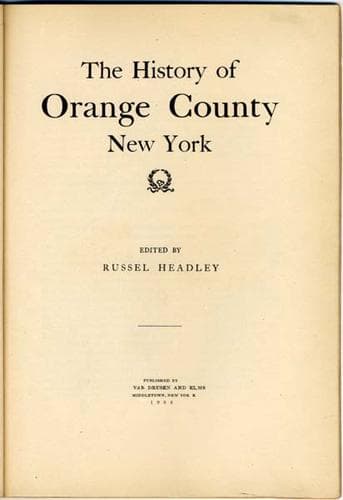
The History of Orange County New York — John Shaqi
The History of Orange County New York
History
The History of Orange County New York
Orange County (N.Y.) -- History
Between Haverstraw and New Paltz Patrick Mac Gregorie, David
Fosbruck, his brother-in-law, and twenty-five others, who were mostly
Scotch Presbyterians, occupied lands at the mouth of the Waoraneck,
and Mac Gregorie purchased for them 4,000 acres on both sides of
Murderer's Creek, on which they settled. Mac Gregorie built his cabin
on Plum Point, then called Conwanham's Hill, and the cabins of his
associates were in the vicinity, and on the south side of the creek
David Toshuck, the brother-in-law, who subscribed himself "Laird of
Minivard," established a trading post. "Within the bounds of the
present county of Orange this was the first European settlement,"
says the historian, but the precise date is not given. Stickney
thinks the year was 1684, but it was probably a little earlier, as
about that time Mac Gregorie entered into the military service of the
State without perfecting his patent, mistakenly trusting Governor
Dongan to protect his interests, who, in 1684, obtained from three
Indian owners their title to a tract extending from New Paltz along
the Hudson to Murderer's Kill, thence westward to the foot of the
high hills, and thence southwesterly along the hills and the river
Peakadasank to a pond; and the same year added by deed from several
Indians another large tract of the land called Haverstraw. These
lands included a part of those which the Indians had previously sold
to Mac Gregorie, and others which they had sold to Stephanus Van
Cortlandt. The latter had preserved his deed, and succeeded in
obtaining a patent attaching them to his manor across the river.
Mac Gregorie was killed in the Leslie revolution of 1691. Governor
Dongan sold his two purchases to John Evans in 1694, and the latter
then proceeded to dispossess Mac Gregorie's widow and her family of
their home, when he granted only leases to them and the other Scotch
settlers. After some years, however, the Mac Gregorie heirs, in
consideration of their original claim, obtained a patent of the Plum
Point farm and a mountain tract.
The fourth and largest settlement was made adjoining "the Christian
patented lands of Haverstraw" by emigrants from Holland, mostly of
the Reformed Dutch Church. They were granted a township patent in
March, 1686, under the name of the town of Orange. There were sixteen
trustees of this grant, which began at the mouth of the Tappan Creek,
extended north to Greenbush, and thence easterly and southerly back
to Tappan Creek. The center of the township was Tappan, where a
church was organized. The trustees of the grant were Claessen Cuyper,
Daniel De Clercke, Peter Harnich, Gerritt Stenmetts, John De Kries,
Sr., John De Kries, Jr., Claes Maunde, John Stratemaker, Staaes De
Groot, Aream Lammatees, Lamont Ariannius, Huybert Gerryts, Johannes
Gerryts, Ede Van Vorst, Cornelius Lammerts.
Public-domain text, read in full here on John Shaqi.
Reviews
Reviews
No reviews yet
Be the first to share your thoughts on this work.
Join the Discussion
Join the discussion
Sign in to leave a comment or review.
Sign InorCreate an account