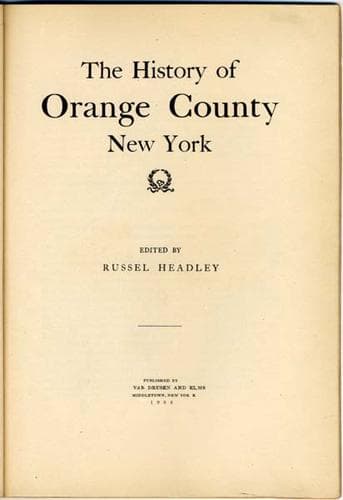
The History of Orange County New York — John Shaqi
The History of Orange County New York
History
The History of Orange County New York
Orange County (N.Y.) -- History
The soil of the semicircular plateau from the Highlands of the Hudson
to the Dans Kamer is mostly a mixture of gravel, sand and clay, which
form a warm and fertile loam. That of the wide Wallkill valley is
alluvium mixed with clay, sand and gravel and is easily worked and
richly productive. So is the soil brought down from the hills in the
town of Deer Park. The lands on the islands of the Drowned Lands are
among the richest in the county. The alluvium of the Otterkill is a
sandy and gravelly loam. In other sections of the county there is an
alternating variety of soils, rich, medium and poor.
[Illustration: Thos. W. Bradley]
CHAPTER V.
EARLY GOVERNMENT
Until after the conquest of New York by the English in 1664 Holland
methods of government, with a local government for each town,
prevailed. The next year the English introduced courts and sheriffs.
In 1682 Thomas Dongan was appointed governor, with directions to
organize a council of not more than ten "eminent inhabitants," and
issue writs for the election by freeholders of a general assembly,
the members of which should consult with the governor and his
council as to what laws were necessary for the good government of
the province. The first meeting of the first general assembly was in
New York in 1683, and it passed fourteen acts, which were assented to
by the governor and his council. One of them established twelve
counties, as follows: New York, Kings, Queens, Suffolk, Richmond,
Westchester, Albany, Ulster, Dutchess, Orange, Duke's and Cornwall.
Except Orange, to be in the care of New York, and Ulster, to be in
the care of Dutchess, the counties were to be entitled to
representation in future general assemblies. Another act established
town courts to be held for the trial of minor cases each month;
county courts and courts of sessions, to be held quarterly or
half-yearly; a general court of oyer and terminer, with original
and appellate power, to be held twice a year in each county; and a
court of chancery, or supreme court, composed of the governor and
his council, for which the governor was empowered to deputize a
chancellor to act in his place.
This was the system of administering justice eight years. Then, in
1691, Courts of Justices of Peace were organized in each town, and
Courts of Common Pleas for each county. In 1701 an act was passed
requiring justices of the peace in each county to meet once a year
at a Court of Sessions, to examine and allow necessary charges
against the county and its towns.
There were supervisors, assessors and collectors in each town from
the first, and in 1691 the freeholders of each town were empowered to
choose three surveyors to lay out and look after highways and fences,
and also to ordain laws and rules for the improvement of village,
pasturage and other lands.
Such were the laws which directed the early administration of
government in Orange County.
Public-domain text, read in full here on John Shaqi.
Reviews
Reviews
No reviews yet
Be the first to share your thoughts on this work.
Join the Discussion
Join the discussion
Sign in to leave a comment or review.
Sign InorCreate an account