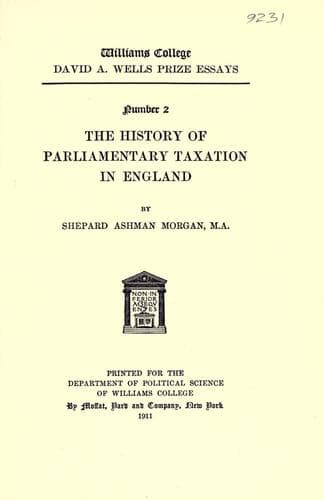
The History of Parliamentary Taxation in EnglandMorgan, Shepard Ashman
History
The History of Parliamentary Taxation in England
Morgan, Shepard Ashman
Taxation -- Great Britain; Taxation -- Great Britain -- History
The opinion of Chief Baron Fleming was scarcely less sweeping. “The
King’s power is double,” he said, “ordinary and absolute.... That
of the ordinary is for the profit of particular subjects, for the
execution of civil justice ... in the ordinary courts, and nominated
... with us the common law; and these laws cannot be changed without
Parliament.... The absolute power of the king is not that which is
converted or executed to private use, ... but is only that which is
applied to the general benefit of the people.... This power is not
guided by the rules which direct only at the common law, and is most
properly named policy and government.... The matter in question is
material matter of state, and ought to be ruled by the rules of
policy, and if it be so, the king hath done well to execute his
extraordinary power. All customs, be they old or new, are no other but
the effects and issues of trades and commerce with foreign nations; but
all commerce and affairs with foreigners ... are made by the absolute
power of the king; and he who hath power of causes hath power also of
effects.”[305]
[The position of Parliament]
Parliament took its stand on the subject of the impositions even before
the decision was published. In the Petition of Grievances sent up by
the commons at the end of the session of 1606, a list which contained
so many complaints that James remarked that “they had sent an oyes
through the nation to find them,” the plea was made that no such duty
could be demanded legally without the consent of Parliament. The
decision was announced to them when they reassembled in November 1606,
but they took no action and for a time the matter rested.
[The Book of Rates published under decision in the Bate Case,
1608]
But it was James himself who, in his characteristic tactless obstinacy,
forced the issue. On the 29th July, 1608, taking advantage of the
Bate decision, he published under the authority of the Great Seal
his Book of Rates, which laid heavy duties upon almost all articles
of merchandise, “to be forever hereafter paid to the king and his
successors on pain of his displeasure.”[306] The statement of James’s
own views on the subject could not be more clearly put than he himself
expressed them in the commission for the levy of the impositions
addressed to the Earl of Salisbury, Treasurer of England. “This special
power and prerogative,” he asserted, “(amongst many others) hath both
by men of understanding in all ages and by the laws of all nations
been yielded and acknowledged to be proper and inherent in the persons
of princes, that they may according to their several occasions raise
to themselves such fit and competent means by levying of customs and
impositions upon merchandise transported out of their kingdom or
brought into their dominions ... as to their wisdoms and discretions
may seem convenient.”[307]
[Remonstrance from the Commons, 1609-10]
Public-domain text, read in full here on John Shaqi.
Reviews
Reviews
No reviews yet
Be the first to share your thoughts on this work.
Elsewhere in the archive
Join the Discussion
Join the discussion
Sign in to leave a comment or review.
Sign InorCreate an account