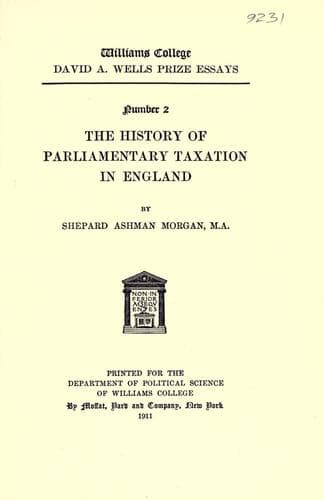
The History of Parliamentary Taxation in EnglandMorgan, Shepard Ashman
History
The History of Parliamentary Taxation in England
Morgan, Shepard Ashman
Taxation -- Great Britain; Taxation -- Great Britain -- History
In 1603, in answer to the agitation against the great monopolies, an
Eastern trading company, known as the Levant Company, surrendered its
charter. This company, amongst other privileges, had enjoyed the right
of collecting a duty on currants from other merchants trading in them,
and paid to the crown in return for the franchise £4,000 a year. When,
therefore, the company yielded up its charter, the crown was the loser
by £4,000 annually. In order to make up for the loss, the crown itself
proceeded to lay a duty on currants.[302] In 1605, the Levant Company
again received a charter, but James levied upon it, nevertheless, his
duty on currants, the rate being five shillings on the hundred-weight
over and above that granted to him by Parliament in its tunnage and
poundage bill. It was a merchant of the Levant Company, John Bate, who
raised the question of the legality of the imposition. The case was
taken to the Court of Exchequer for decision. Had the barons confined
themselves to the strict laws of the matter, there would not have been
great ground for objection to their decision. Precedent drawn from the
time of the Tudors and statutes of the same period, were capable of
being brought forward in a fair adjudication of the case, and would
have substantiated the contention of the crown, thus returning customs
exactions, nearly to the situation of 1300.[303] The fact that the
four barons decided the case unanimously against John Bate could not,
therefore, be reasonably reprehended. But they permitted themselves to
slip off into philosophical generalizations which struck the people as
absolutist in tenor.
[Opinions of the Barons in the Bate Case]
“It seemeth to me strange,” says Baron Clarke in his opinion, “that
any subjects would contend with the King in this high point of
prerogative.... As it is not a kingdom without subjects and government,
so he is not a king without revenues.... The revenue of the Crown is
the very essential part of the Crown, and he who rendeth that from the
king pulleth also his crown from his head, for it cannot be separated
from the crown.” He proceeded to advance the opinion that the Statute
of Edward III[304] which prohibited to the crown the right of levying
new impositions on wool, woolfells, and leather, and which provided
that there be only imposed “the custom and subsidy granted to the
king,” had no effect in the present instance, because it extended to
Edward III alone, “and shall not bind his successors, for it is a
principal part of the Crown of England which the King cannot diminish.”
Public-domain text, read in full here on John Shaqi.
Reviews
Reviews
No reviews yet
Be the first to share your thoughts on this work.
Elsewhere in the archive
Join the Discussion
Join the discussion
Sign in to leave a comment or review.
Sign InorCreate an account