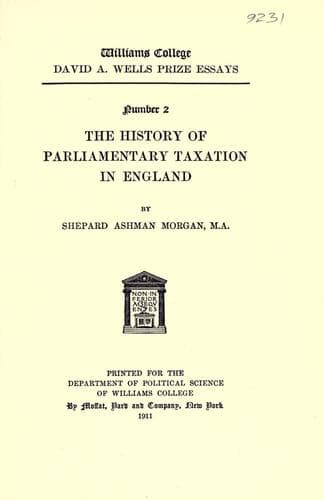
The History of Parliamentary Taxation in EnglandMorgan, Shepard Ashman
History
The History of Parliamentary Taxation in England
Morgan, Shepard Ashman
Taxation -- Great Britain; Taxation -- Great Britain -- History
James’s attempt at absolutism was not a financial success; a court
which was as extravagant as it was dissolute helped him increase his
deficit; he ran behind about £200,000 a year, notwithstanding the
fact that he set in motion all the machinery of petty extortion that
he dared. He tried to force loans on the security of his privy seal
but frequently met with refusal from which there was no appeal. The
jurisdiction of the Star Chamber was used as a means to lay fines which
were usually unjust and always excessive. He sold peerages and raised
money on the crown lands, and induced the French king and the Dutch to
pay up old debts owing to England.
[James’s second Parliament, 1614, known as the “Addled
Parliament”]
His enormous annual deficit forced him in 1614 to summon his second
Parliament. It came with a great and active majority lined up against
the king. It speedily passed by a unanimous vote a resolution against
the king’s right of imposing taxes without the consent of Parliament,
and demanded a conference on that subject with the House of Lords;[313]
the lords, however, turned to the judges hoping to obtain from them
enlightenment on the legal points involved, but the judges, by the
words of Chief Justice Coke, refused to render an extra-judicial
opinion. The conference was then refused. The king, becoming impatient
at the delay of the commons in accomplishing the purpose for which
he had summoned them to Parliament, with his usual failure to adapt
himself to circumstances, sent a message to the House threatening a
dissolution of Parliament unless procedure were immediately taken in
the direction of granting supplies.[314] The commons met the issue
squarely; they said that they were determined to conclude the matter
of the impositions before granting a supply. On the 7th of June, two
months and two days after the date upon which it had been convened,
James redeemed his word and dissolved Parliament. It had not passed
a single bill and thus earned the title by which it is known to
history,--the “Addled” Parliament. But it had succeeded in maintaining
its principle of making supply wait upon redress of grievances, and
some of its members had shot barbed shafts at the king, wherefore James
locked up those who had aimed most surely.
[Resort to extortion]
With the hope gone of securing a grant, James had to return to his old
courses of obtaining income. Forced loans, monopolies, heavy fines,
feudal payments rigorously exacted, and the systematic extortion of
benevolences, figured in his programme. The Council sent out orders
to all the sheriffs and magistrates to send in contributions from all
men of ability to pay; to those who refused, suggestions were made of
impending evil. The judges of assize were especially urged to recommend
payments. The benevolences netted less than £43,000 for the three years
during which they were made.[315]
[Case of Oliver St. John]
Public-domain text, read in full here on John Shaqi.
Reviews
Reviews
No reviews yet
Be the first to share your thoughts on this work.
Elsewhere in the archive
Join the Discussion
Join the discussion
Sign in to leave a comment or review.
Sign InorCreate an account