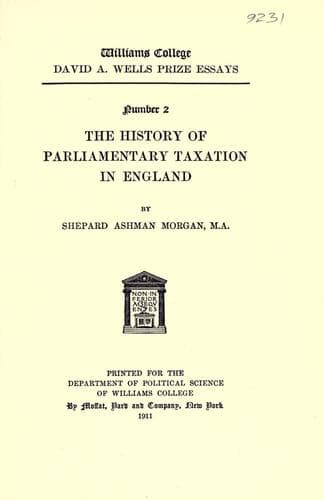
The History of Parliamentary Taxation in EnglandMorgan, Shepard Ashman
History
The History of Parliamentary Taxation in England
Morgan, Shepard Ashman
Taxation -- Great Britain; Taxation -- Great Britain -- History
But the nation did not submit tamely. Several counties sent up
protests against the demand, recalling in defense of their position
the Statute of Richard III which forbade the levying of “exactions,
called benevolences.” The refusal of Oliver St. John to the request for
a benevolence by the mayor of Marlborough, brought him into immediate
conflict with the king. His written reply to the mayor maintained the
illegality of the demand on the ground that it was contrary to Magna
Carta and to the Statute of Richard III. He further charged the king
with breaking his coronation oath, and declared that all who paid the
benevolence were incriminated with him. He was haled before the Star
Chamber and sentenced by it to pay a fine of £5,000 and to imprisonment
during the king’s pleasure. Thus it was that James tried to rule
without a Parliament.
[James’s third Parliament, 1620-21]
But the rule could not long continue. James summoned his third
Parliament for the 30th January, 1620-21. He addressed both Houses
in a conciliatory manner, hopefully and with many promises. “For you
to hunt after grievances,” he said, “to the prejudice of your king
and yourselves, is not the errand: deal with me as I deserve at your
hands; I will leave nothing undone that becomes a just king, if you
deal with me accordingly.”[316] The commons were in a good temper and a
reconciliation seemed far more likely to eventuate than a struggle.
[Supply waits upon redress of grievances]
As for the royal advice about grievances, the commons were slow to
take it. When, shortly after the beginning of the session, it was
moved that the House proceed to the consideration of a supply, it
was stated that supply and redress of grievances should go “hand in
hand together,” that they were “as twins; to go together and have no
precedency.”[317] It was resolved that the business of the supply
be not decided independently of a consideration of grievances and
of a petition to the king for freedom of speech, thus recalling the
imprisonment of members in 1614 at the time of the dissolution of the
Addled Parliament.
[Revival of impeachment by the Commons]
High in the list of grievances was the granting of monopolies. Patents
of monopoly subserved a number of diverse purposes, some of which were
entirely legitimate. Objection could not be made to restrictions in
the sale of certain commodities such as liquors and explosives, nor to
the assurance given to an inventor that he had an exclusive right to
profits accruing from his invention. But James was free with his grants
of monopoly for the enrichment of his courtiers and himself. Parliament
laid by the heels the monopolists who had most abused their privileges,
and impeached and condemned Sir Giles Mompesson and Sir Francis
Mitchell.[318]
[Granting of a supply]
Public-domain text, read in full here on John Shaqi.
Reviews
Reviews
No reviews yet
Be the first to share your thoughts on this work.
Elsewhere in the archive
Join the Discussion
Join the discussion
Sign in to leave a comment or review.
Sign InorCreate an account