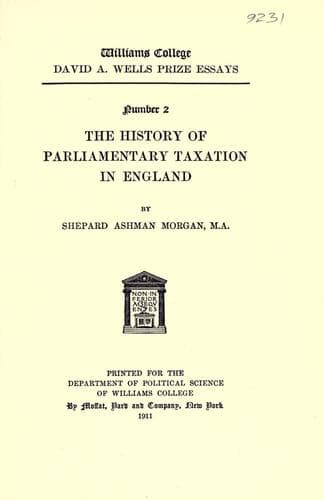
The History of Parliamentary Taxation in EnglandMorgan, Shepard Ashman
History
The History of Parliamentary Taxation in England
Morgan, Shepard Ashman
Taxation -- Great Britain; Taxation -- Great Britain -- History
During the six months which elapsed before the reassembling of
Parliament, Charles continued to levy tunnage and poundage upon his
own authority, relying still upon the decision in the Bate Case for
his justification. Several merchants who refused to pay were promptly
clapped into prison; among those whose goods were seized for the same
reason was Henry Rolles, a member of the House of Commons. The second
session of Parliament was called for the 20th January, 1628-29; the
commons came together with no pretense of smothering their indignation
against the conduct of the king. A number of plans were brought forward
as means of rectifying the abuses. The evident determination of the
commons to conclude the matter, daunted the king. Summoning both Houses
to Whitehall, he renounced the right of levying tunnage and poundage.
“It ever was, and still is my meaning,” so were his words, “by the gift
of my people to enjoy it, and my intention in my speech at the end
of the last session was not to challenge tunnage and poundage as of
right, but _de bene esse_, showing you the necessity, not the right,
by which I was to take it until you had granted it to me, assuring
myself according to your general professions that you wanted time and
not good-will to give it me.”[346] For a moment it appeared as though
this abandonment of position by the king would end the conflict. Three
days after his reception of the Houses at Whitehall, Mr. Secretary
Cooke moved the reading of a bill granting him tunnage and poundage for
life. But it never passed. The commons were distracted by a question
of religious innovation, talked at great length over their religious
grievances, and allowed their momentary flush of cordial feeling
toward the king to cool. Mr. Secretary Cooke on the two days following
that upon which he made his motion regarding tunnage and poundage,
delivered messages from Charles urging haste in the consideration of
the measure.[347] On the 2nd February, the commons acknowledged the
receipt of the messages, but rather than pass a bill satisfactory to
the king in this particular, they stated their intent to “proceed with
religion.”[348]
Public-domain text, read in full here on John Shaqi.
Reviews
Reviews
No reviews yet
Be the first to share your thoughts on this work.
Elsewhere in the archive
Join the Discussion
Join the discussion
Sign in to leave a comment or review.
Sign InorCreate an account