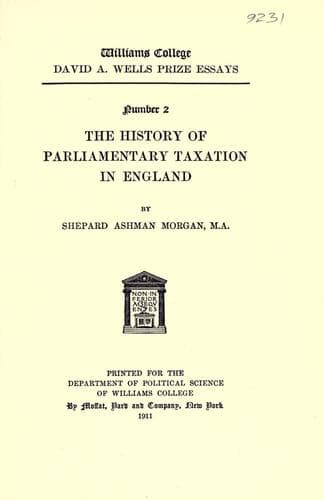
The History of Parliamentary Taxation in EnglandMorgan, Shepard Ashman
History
The History of Parliamentary Taxation in England
Morgan, Shepard Ashman
Taxation -- Great Britain; Taxation -- Great Britain -- History
The Petition which thus became a regularly passed Act of Parliament,
is of transcendent importance in the development of the control of
the people over the public purse. In terms absolutely unequivocal,
it asserts that “your subjects have inherited this freedom, that they
should not be compelled to contribute to any tax, tallage, aid, or
other like charge, not set by common consent in Parliament.” The
statutory sources whence that freedom was inherited are cited in
detail. The citations, are, however, ill-taken. _Statutum de tallagio
non concedendo_ was in all likelihood no statute at all, but a
chronicler’s abstract of Edward I’s Confirmatio Cartarum, or perhaps an
unauthoritative copy of the pardon which was granted to Humfrey Bohun
and Roger Bigod at approximately the same time with the Confirmation
of the Charters. It is not unlikely that the citation of the statute
of the 25th of Edward III was an error; at any rate, the text of the
statute has not been discovered,[343] and the date at which it was said
to be enacted was at the height of the great plague, a time scarcely
adapted to the assertion of a great constitutional principle. But
the precise historical foundation upon which Sir Edward Coke and his
associates based their charges against the king, is of quite secondary
importance. The true value of the Petition of Right lies in this, that
Charles I had been obliged to subscribe to a statutory provision by
which no man thereafter was to “be compelled to make or yield any gift,
loan, benevolence, tax, or such like charge, without common consent by
Act of Parliament.” That was indeed supremely important.
[The Petition of Right and customs duties]
But the language of the Petition of Right might reasonably be taken
to refer only to internal taxes and that the matter of customs
duties, the charges upon merchandise at the outports, was left still
in the air. Protests had indeed been made against the exaction of
these duties by the crown, especially during the reign of James in
the great agitation over the Book of Rates, but no statute had been
passed providing definitely for parliamentary control. To that end,
the commons delayed the passage of a bill which gave the king tunnage
and poundage for life, pending the acceptance by him of a remonstrance
against impositions. The remonstrance as framed by the commons declared
that “there ought not any imposition to be laid upon the goods of
merchants, exported or imported, _without the common consent by Act
of Parliament_.”[344] It further made assertion that the laying of
impositions at the outports was contrary to the Petition of Right. The
king’s attitude was decisive; before the remonstrance was handed to
him, he evaded the issue by proroguing Parliament. Never, so he said,
would he give away tunnage and poundage; he must needs retain them for
himself. The session ended 26th June, 1628.[345]
[Tunnage and poundage]
Public-domain text, read in full here on John Shaqi.
Reviews
Reviews
No reviews yet
Be the first to share your thoughts on this work.
Elsewhere in the archive
Join the Discussion
Join the discussion
Sign in to leave a comment or review.
Sign InorCreate an account