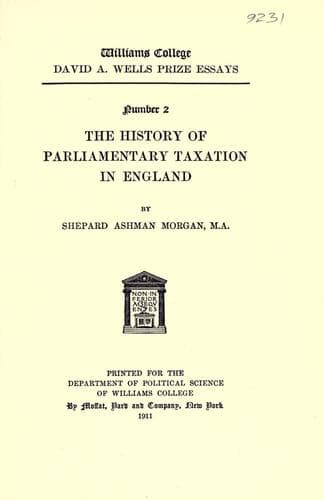
The History of Parliamentary Taxation in EnglandMorgan, Shepard Ashman
History
The History of Parliamentary Taxation in England
Morgan, Shepard Ashman
Taxation -- Great Britain; Taxation -- Great Britain -- History
[Charles’s eleven years without Parliament, 1629-40]
With the dissolution of his third Parliament, Charles entered upon a
new epoch in his reign; and at the conclusion of it, he found that his
game had been for too heavy stakes, and that he had lost. For eleven
years he did without a Parliament. He began by issuing a Declaration
addressed to his “loving subjects” in which he told the history of the
late session from his own point of view,--that he was in extreme need
of money with which to meet the necessities of England and relieve the
“miserable afflicted state” of Protestants abroad, that Parliament had
proved itself intractable, and had greatly delayed, contrary to all
precedent, in the matter of tunnage and poundage; not only that, but
upon his graciously yielding to Parliament the power of granting him
tunnage and poundage, it had raised up still another cause for delay in
the case of Henry Holles.[352] In a proclamation issued two weeks later
he plainly exhibited his intention to rule without a Parliament; “the
calling, continuing, and dissolving of them,” he said, “being always in
the King’s own power. And his Majesty shall be more inclinable to meet
in Parliament again when his people shall see more clearly into his
intents and actions, when such as have bred this interruption shall
receive their condign punishment.”[353]
[His financial expedients]
He imprisoned accordingly Holles, Strode, Sir John Eliot and others
whom he included amongst the vipers of the commons, and removed such
of them to the Tower as were able to sue out their writs of habeas
corpus, in order that he might thus elude the service of the writs. But
imprisonment was scarcely a means of relief to the king’s financial
exigencies. He turned to expedients which were exceedingly oppressive,
and most of them clearly illegal. He rigorously extorted tunnage and
poundage by the arbitrary authority of the crown; he reëstablished the
monopolies abolished under James I, and applied them to nearly every
article in common use; he revived laws long since dead and applied them
stringently for the sake of their fines; he revived forest legislation
and increased the limits of the royal woodlands, mulcting the owners of
adjoining property for encroachment; he searched titles of estates for
defects which would make them liable to reversion to the crown; he went
back to the old practice of compulsory knighthood for those who had
£40 or more in lands or rents.
[Ship money, first writ, 20th October, 1634]
Public-domain text, read in full here on John Shaqi.
Reviews
Reviews
No reviews yet
Be the first to share your thoughts on this work.
Elsewhere in the archive
Join the Discussion
Join the discussion
Sign in to leave a comment or review.
Sign InorCreate an account