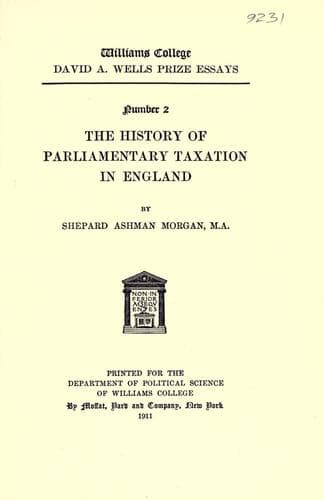
The History of Parliamentary Taxation in EnglandMorgan, Shepard Ashman
History
The History of Parliamentary Taxation in England
Morgan, Shepard Ashman
Taxation -- Great Britain; Taxation -- Great Britain -- History
But the supreme grievance was the extortion of ship money. Sir William
Noy, lately leader in the commons in defense of popular power against
royal prerogative, now become by the grace of the king attorney-general
and a chief supporter of that same royal prerogative, shut himself up
in the Tower for some days that he might better consult the ancient
authorities. “Shaking off the dust of ages from parchments in the
Tower,” says Hallam, “this man of venal diligence and prostituted
learning discovered that the seaports and even maritime counties had
in early times been sometimes called upon to furnish ships for the
public service; nay there were instances for a similar demand upon some
inland places.”[354] The first writ of ship money was directed to the
magistrates of London and other seaport towns, and was issued on the
20th October, 1634. It recited the depredations of pirates, “Turks,
enemies of the Christian name,” and the prevalence of war upon the
continent. It enjoined upon the magistrates the furnishing of ships
of specific tonnage and equipage by the 1st of the following March.
They were empowered to assess all the inhabitants according to their
substance, both for the fitting out of the ships and the maintenance
of their crews for the space of six months. Refusals to pay were
punishable by imprisonment. The writ was issued by the king with the
advice of the Privy Council.[355]
[The true occasion for the levy]
The show of precedent was barely an extenuation, not a justification
of the demand. As a matter of fact, it was virtually an extortion of a
tax, and as such was a distinct violation of the Petition of Right.
London, being the only port in the kingdom capable of constructing and
equipping ships of the character designated in the writs, was the only
town able to make literal compliance with the demand. The rest were
obliged to make money payments. But the matter was to come up later in
the courts, and the legality or illegality of the writs was there to
be decided. As for the occasion of the requisition denominated in the
ordinance, that was false. The design was not against “Turks, enemies
of the Christian name,” but against the Dutch Republic. Charles had
proposed a secret treaty with Spain whereby the government of the
Lowlanders should be overthrown and its territory be divided between
England and Spain.[356] Not only was this act of Charles a breach of
his recent great compact with the nation, but it had for its purpose
an act of aggression against the people who stood for the highest
political ideals then known in Europe, and was based on a lie.
[Second writ, 4th August, 1635. Its general application]
Public-domain text, read in full here on John Shaqi.
Reviews
Reviews
No reviews yet
Be the first to share your thoughts on this work.
Elsewhere in the archive
Join the Discussion
Join the discussion
Sign in to leave a comment or review.
Sign InorCreate an account