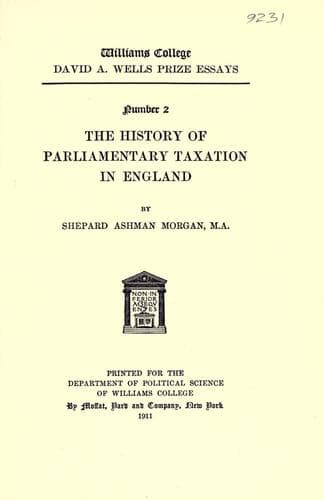
The History of Parliamentary Taxation in EnglandMorgan, Shepard Ashman
History
The History of Parliamentary Taxation in England
Morgan, Shepard Ashman
Taxation -- Great Britain; Taxation -- Great Britain -- History
On the 7th February, 1637, Charles laid the case before the judges of
the Exchequer extra-judicially in much the same terms as the opinion
of 1635. He requested an answer to the following question:--“When
the good and safety of the Kingdom in general is concerned, and the
whole Kingdom in danger, whether may not the King, by writ under the
Great Seal of England, command all the subjects of our Kingdom at
their charge to provide and furnish such a number of ships, with men,
victuals, and munition, and for such time as we shall think fit for the
defence and safeguard of the kingdom from such danger and peril, and
by law compel the doing thereof, in case of refusal or refractoriness:
and whether in such a case is not the King the sole judge both of the
danger, and when and how the same is to be prevented and avoided?”[359]
The opinion of the judges was ostensibly unanimous in favor of the
crown; Coke and Hutton as a matter of fact dissented, but subscribed on
the principle that the opinion of the majority should be that of the
whole body.
[Hampden’s Case, 1637]
In the face of this sweeping and conclusive opinion delivered privately
to the king, there was apparently no hope for any one who should have
to answer in that court for refusal. Shortly thereafter, however,
such a case came up. John Hampden, a gentleman of Buckinghamshire, had
refused to pay the assessment of 20_s._ which was laid upon some of his
lands, and by reason of his refusal was summoned to the Exchequer. He
appeared and answered to the charge in November, 1637. He was defended
by the brilliant Oliver St. John and Mr. Holborne. Solicitor General
Littleton and Attorney General Bankes conducted the case for the crown.
The question upon which the case was argued may be phrased as follows:
“Whether the king had a right on his own allegation of public danger
to require an inland county to furnish ships, or a prescribed sum of
money by way of commutation, for the defense of the kingdom?”[360] The
argument for Hampden can be summed up under five heads:
[The case for the defendant]
I. The law and constitution of England provide certain ordinary
revenues for the defense of the realm. These comprehend the military
forces provided by those holding lands by military tenure; the
liability of the Cinque Ports and others holding similarly to provide
a quota of ships, by reason of their tenure; the feudal and other
revenues inherent in the crown; the customs on wool and leather, and
tunnage and poundage, and other special dues which were wont to be
granted to the king in time of danger.[361]
Public-domain text, read in full here on John Shaqi.
Reviews
Reviews
No reviews yet
Be the first to share your thoughts on this work.
Elsewhere in the archive
Join the Discussion
Join the discussion
Sign in to leave a comment or review.
Sign InorCreate an account