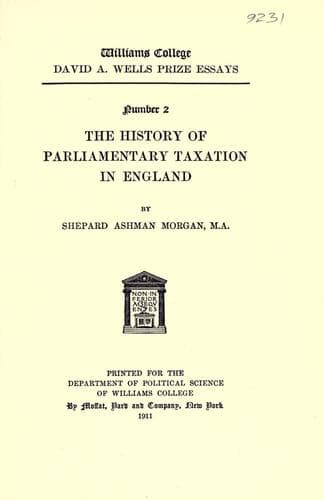
The History of Parliamentary Taxation in EnglandMorgan, Shepard Ashman
History
The History of Parliamentary Taxation in England
Morgan, Shepard Ashman
Taxation -- Great Britain; Taxation -- Great Britain -- History
Parliament lost no time in setting about its work. Proceedings were
immediately instituted looking to the impeachment of the Earl of
Strafford, Archbishop Laud, Finch, and six of the judges who had
figured in the ship money case. Various victims of the tyrannical
jurisdiction of the Star Chamber were set at liberty. The commons
exhibited their uncompromising hostility to the king by voting
assistance to their “brethren” the Scots, whose army was in possession
of much territory on the English side of the border. They granted them
£25,000 a month as long as their stay in England should be needful, and
in addition £300,000 as an indemnity.
[Royal exaction of tunnage and poundage declared illegal]
With such acts of open opposition to the king in process, it was
natural that Parliament should set itself to clean up all the abuses
which of recent times had crept into the government. Its actions were
not subversive of the constitution; on the contrary it left unassailed
many prerogatives of the king. On the 22nd June, 1641, Parliament
granted to the king tunnage and poundage for a length of time somewhat
less than two months[372] and in the same bill declared, “that it is
and hath been the ancient right of the subjects of this realm, that no
subsidy, custom, impost, or other charge whatsoever ought or may be
laid or imposed upon any merchandise exported or imported by subjects,
denizens, or aliens without common consent in Parliament.”[373] The Act
prescribed also the punishment which should be inflicted upon officers
who in time to come should exact payments not sanctioned by Parliament.
They were to “incur and sustain the pains, penalties, and forfeitures
ordained and provided by the Statute of Provision and Premunire made in
the sixteenth year of King Richard II, and shall also from thenceforth
be disabled during his life to see or implead any person in any action
real, mixed, or personal, or in any court whatsoever.” Thus was it
enacted that tunnage and poundage exacted by authority of the crown
was illegal, and protected merchants from being sued by the customs
officers in case of refusal to pay the unlawful imposition. The king
received tunnage and poundage by six subsequent acts for short terms
down to the 2nd July, 1642.
[The Ship Money Act, 7th August, 1641]
Public-domain text, read in full here on John Shaqi.
Reviews
Reviews
No reviews yet
Be the first to share your thoughts on this work.
Elsewhere in the archive
Join the Discussion
Join the discussion
Sign in to leave a comment or review.
Sign InorCreate an account