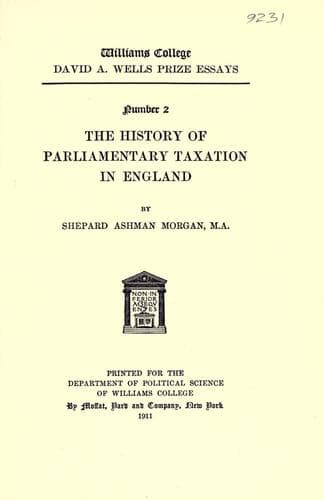
The History of Parliamentary Taxation in EnglandMorgan, Shepard Ashman
History
The History of Parliamentary Taxation in England
Morgan, Shepard Ashman
Taxation -- Great Britain; Taxation -- Great Britain -- History
The king had reason to regret his intrusion since the dispute which he
had caused delayed a supply from the commons so much the more. He now
had recourse to a compromise. He offered the withdrawal of his claim
to ship money in consideration of a grant of twelve subsidies,[368]
payable in three years. The commons, perceiving that the proposition,
if acceded to, involved the tacit admission that the ship money
had been justly laid, insomuch as its removal was obtainable only
by purchase, refused to enter into the agreement. But the effect of
the message was not quite lost; on the contrary it seemed as though
the king would shortly receive his grant. At the moment when the
commons were on the point of deciding upon a supply, the amount to
be determined subsequently, Sir Henry Vane, secretary of state,
precipitated a crisis. He asserted that the supply would not be
accepted unless it were to the amount and in the manner designated in
the king’s message.[369] The next day, the 5th May, the king dissolved
his three-weeks-old Parliament, to his own great distress and the
trepidation of the nation.
[Dissolution of Parliament]
Charles employed the six months which intervened between the
dissolution of Parliament and the summons of the Long Parliament in
his usual occupations. He locked up several members of the House. He
exacted forced loans, created new monopolies, and levied ship money.
Prosecutions followed swiftly upon refusals to pay. “Coat and conduct
money,” a new exaction from the counties, was demanded to cover the
traveling expenses of recruits on their way to fight against the Scots.
He obtained six subsidies from the clergy whom he illegally kept in
convocation after the dissolution of Parliament.
[Sitting of the Long Parliament, 3rd November, 1640]
The wind of opposition was rising to a gale. With the sitting of the
Long Parliament, which convened on the 3rd November, 1640, the tempest
broke. The immediate occasion of the summons was the universal demand
of the people and the peers for a session of Parliament, coupled
with emptiness of the treasury which came with the commencement of
the disastrous Scottish war. The composition of the commons was
overwhelmingly anti-regal;[370] the popular leaders had been at work
in the counties ever since the dissolution of the Short Parliament
looking to the return of a strong majority in opposition to the king.
The assembly convened full of the idea that “they had now had an
opportunity to make their country happy by removing all grievances and
pulling up the causes of them by the roots, if all men would do their
duties.”[371]
Public-domain text, read in full here on John Shaqi.
Reviews
Reviews
No reviews yet
Be the first to share your thoughts on this work.
Elsewhere in the archive
Join the Discussion
Join the discussion
Sign in to leave a comment or review.
Sign InorCreate an account