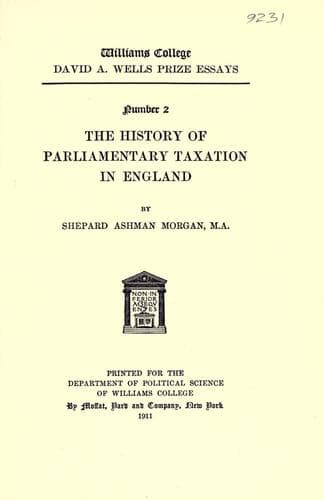
The History of Parliamentary Taxation in EnglandMorgan, Shepard Ashman
History
The History of Parliamentary Taxation in England
Morgan, Shepard Ashman
Taxation -- Great Britain; Taxation -- Great Britain -- History
Charles II came to the throne in 1660 after the English people had
made an eleven years’ trial of a military despotism under a good
and moderate despot. His first Parliament, that of 1660, granted
him the proceeds of the customs for life. During the period of the
Commonwealth, the freedom from the feudal charges had been most
agreeable to those holding of the crown. Consequently, this Parliament
set itself to regulate the confused system of military tenure by the
simple expedient of abolition. The Great Contract which had been
proposed under James I for the same purpose, had been advocated in
vain. Now, however, the effort was successful. The feudal incidents,
such as wardships, marriages, knight’s service, as well as the three
feudal aids, knighting the king’s son, ransoming the king, and
furnishing dowry for his eldest daughter, were done away with. By this
great deprivation, the royal revenue was naturally much prejudiced.
Parliament made up the loss by granting to the crown an hereditary
excise on beer and some other liquors, increasing the royal revenue to
the annual value of £1,200,000.[378]
[Appropriation of supplies, 1665]
In 1665 the expenses incident to the Dutch War made it possible to
establish a principle which had been touched upon from time to time
since the days of Henry III. Sir George Downing, in the subsidy bill
of that year, introduced the provision that the money raised in
accordance with the bill, £1,250,000, be applicable solely to the
prosecution of the war, and that the money could not be paid out by
the Exchequer save by special warrant stating that as the purpose of
the payment. Clarendon opposed the measure as an encroachment upon the
honor of the crown, but Charles himself was not averse to it, mainly
by reason of his belief that the promised revenue would be thus more
acceptable to bankers as the security for loans. The appointment in the
following year of a commission to examine the public accounts in order
to determine the faithfulness with which the provision was carried
out, clinched the principle underlying its original passage. The bill
was the natural consequence of the liberty of appropriation enjoyed
under the Commonwealth. The exercise of the principle of appropriating
supplies in detail was not carried to its full extent until after
1689. Its importance is difficult to overestimate. It placed the
executive power in a position of perfect dependence upon the will of
Parliament, for the money requisite for any administrative act was to
be forthcoming only in accordance with the previously expressed intent
of Parliament.
[Reign of James II, 1685-88]
Public-domain text, read in full here on John Shaqi.
Reviews
Reviews
No reviews yet
Be the first to share your thoughts on this work.
Elsewhere in the archive
Join the Discussion
Join the discussion
Sign in to leave a comment or review.
Sign InorCreate an account