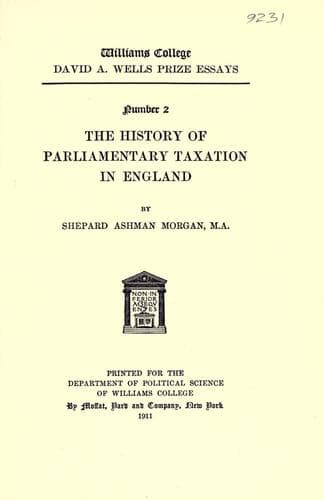
The History of Parliamentary Taxation in EnglandMorgan, Shepard Ashman
History
The History of Parliamentary Taxation in England
Morgan, Shepard Ashman
Taxation -- Great Britain; Taxation -- Great Britain -- History
The reign of James II, who came to the throne in 1685 at the death
of Charles, was retrogressive. He assumed the crown with the full
intention of exercising arbitrary authority, and if he had not tried to
substitute Catholicism for the Established Church, there is little to
show that he would not at least for a time have succeeded. Before the
summons of his Parliament, which he called reluctantly notwithstanding
a lapse of five years under Charles without one, he continued to
himself the payment of the customs duties by proclamation. This illegal
act met with no serious objection from Parliament when it met. Nor
was this all; Parliament raised the permanent revenue of the king to
the annual amount of £2,000,000, and on the suppression of Monmouth’s
rebellion, gave him £700,000 more wherewith to support a standing army.
Thus did Parliament make James financially independent, provided he
was content to live within reason, and gave him an army in addition.
This was a combination of powers which on the Continent had sufficed to
create despotisms.
[William and Mary]
That it did not create a despotism in England is not greatly to be
wondered at. James set himself to fighting the battle of the Roman
Catholic church in England. The result was almost immediate disaster.
On the 5th November, 1688, William, Prince of Orange, and Stadtholder
of the United Provinces, landed at Torbay in Devonshire. He was
requested by seventy of the lords spiritual and temporal (all who
were then in London), by the members of the House of Commons which
met in the last Parliament of Charles II, and the corporation of the
City of London, to assume the provisional government of the kingdom
pending a session of Parliament. This was called for the 22nd January,
1688-89. On the 13th February following, a tender of the crown was
made to William, on the conditions denominated in the recently framed
Declaration of Right. In it the illegal acts of King James were recited
and the announcement was made that the throne had been abdicated;
it was asserted also that certain specified acts of King James were
illegal, and a resolution was appended settling the crown on William
and Mary. William, speaking for himself and for the Princess Mary,
“thankfully accepted what had been offered them.”
[The Bill of Rights, 1689]
The Declaration of Right, with some slight but essential changes,
was incorporated at the second session of this Parliament, the 25th
October, 1689, in statutory form known subsequently as the Bill of
Rights.[379] In the matter of taxation, it sums up in a few clauses the
whole principle which had been in course of evolution since the German
chieftains received gifts of cattle and fruits from their people.
Public-domain text, read in full here on John Shaqi.
Reviews
Reviews
No reviews yet
Be the first to share your thoughts on this work.
Elsewhere in the archive
Join the Discussion
Join the discussion
Sign in to leave a comment or review.
Sign InorCreate an account