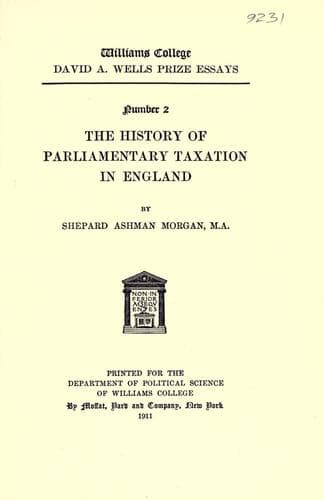
The History of Parliamentary Taxation in EnglandMorgan, Shepard Ashman
History
The History of Parliamentary Taxation in England
Morgan, Shepard Ashman
Taxation -- Great Britain; Taxation -- Great Britain -- History
Buckingham, 262-264, 265, 269.
Burghers, at Parliament of 1265, 102-103;
acquire function of taxing, 116-119.
_Carta Mercatoria_, 158;
complaint against, 162.
Carucage, 43, note 1;
imposition by Richard I, 43;
a revival of the Danegeld, 35, note 1;
levy of 1198, 44;
“assessed” by the Common Council, 77-78.
Charles I, his accession, 261;
signs Petition of Right, 269;
renounces tunnage and poundage, 274-275;
rules without Parliament, 279.
Charles II, his accession, 302;
death, 304.
Clergy, John’s antagonism of, 55;
need of their assent to taxation recognized, 125;
meet separately, 131, note 1;
attempted taxation of by Parliament, 1449, 210;
taxation after English Reformation, 228-230.
_Clericis laicos_, 133, note 1;
tendency to disregard, 1297, 142, 145;
adduced in 1301, 156.
Common Council, no provision for London representatives made in Magna
Carta, 66;
its composition, 66-68;
representation, 68-69;
part in taxation in early years of Henry III, 77-78;
grants a tax on movables, 1224, 79-81;
instances of refusal, 1232 and 1237, 81-82;
refuses a grant, 1242, 85;
its control over taxation in 1250, 91-92;
knights of the shires called, 1254, 92-94;
its control of disbursements, see Disbursements.
Commons, House of, foreshadowed in Parliament of 1265, 102, 103;
meets separately, 189, 190;
initiation of tax levies, 205-208, 308;
composition dictated by James I, 238;
revival of impeachment, 256;
breach of privilege in Short Parliament, 293.
_Commune Concilium_, see Common Council.
Conditional grant, early instance of, 1224, 79-80;
repetitions, 81-82.
_Confirmatio Cartarum_, action prior to, 142-144;
signed by Edward I, 145;
analysis of tax clauses, 146-150;
marks a stage in Parliamentary taxation, 152-153.
Contributions, voluntary, among the early Germans, 2, 3.
Cowel’s “Interpreter,” 248.
Customs, in early England, 113, note 1;
_Carta Mercatoria_, 158;
statutory provision for control by Parliament, Edward III, 177-178;
persistence of the struggle over customs, 179-180;
Bate Case, 242-244;
Book of Rates, 245;
collection ordered by Charles I, 265;
omission in Petition of Right, 273.
See also under New Customs, Ancient Customs.
Danegeld, origin 991 and early instances, 6-7;
authority for its exaction, 8-9;
reimposition under the Conqueror, 15-16;
under William Rufus, 18;
Stephen’s promise of abolition, 25-26;
supposed cause of Woodstock Controversy, 27, note 3;
its disappearance from the Rolls, 35, and note 1;
revival as “carucage,” 35, 43.
_De tallagio non concedendo_, 150-151, 159, 167;
cited in Petition of Right, 271.
Disbursements, rejection of commission for, 82-83, 85;
demand for supervision of, 87-88;
Matthew Paris’s scheme, 88.
Public-domain text, read in full here on John Shaqi.
Reviews
Reviews
No reviews yet
Be the first to share your thoughts on this work.
Elsewhere in the archive
Join the Discussion
Join the discussion
Sign in to leave a comment or review.
Sign InorCreate an account