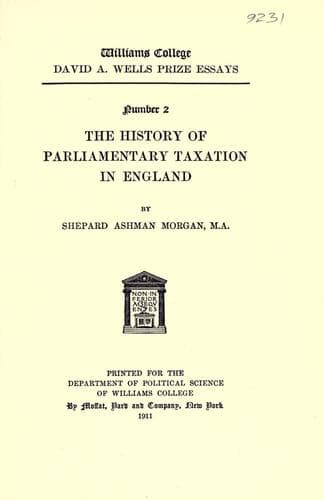
The History of Parliamentary Taxation in EnglandMorgan, Shepard Ashman
History
The History of Parliamentary Taxation in England
Morgan, Shepard Ashman
Taxation -- Great Britain; Taxation -- Great Britain -- History
It states that King James “did endeavor to subvert and extirpate ...
the laws and liberties of this kingdom ... by levying money for and to
the use of the crown, by pretense of prerogative, for other time and in
other manner than the same was granted by Parliament.” Then follows the
definite assertion, “that levying money for or to the use of the crown
by pretense of prerogative, without grant of Parliament for longer time
or in other manner than the same is or shall be granted, is illegal.”
The clause which gave to these statements the force of law, emphasizes
the power of Parliament. “All which their Majesties are contented and
pleased,” so it goes, “shall be declared, enacted, and established
by authority of this present Parliament, and shall stand, remain,
and be the law of this realm forever; and the same are by their said
Majesties, by and with the advice and consent of the Lords spiritual
and temporal, and Commons, in Parliament assembled, and by the
authority of the same, declared, enacted and established accordingly.”
With the passing of the Bill of Rights the principle was vindicated in
its fullness that Parliament rather than the crown has the power to
tax. Within Parliament itself the power of laying taxes had undergone
further differentiation in that the House of Commons claimed the
sole right of initiating tax levies. The theory deduced therefrom,
that the House of Commons has sole control over money bills and that
interference by the House of Lords is an assumption of power beyond
the constitutional rights of that House, came up for fuller definition
220 years later. The corollary principle that Parliament has the power
to appropriate supplies for specific purposes and that it can demand
an accounting for the money so appropriated were accorded general
acquiescence then and thereafter.
INDEX
Accounts, examination of, 186-188;
appointment of treasurers under Richard II, 191-194;
under Charles II, 303;
after Bill of Rights, 308.
Aid _pur fille marier_, Edward I, 121.
Ancient Customs, rate stated, 165.
Anglo-Saxons, their early ideas of taxation, 3.
Appropriation of Supplies, 184-186;
declaration under Henry VI, 210;
under Charles II, 303-304;
after Bill of Rights, 308.
Assize of Arms, 35.
_Auxilium vicecomitis_, 27, 29.
Bate Case, 241-242;
opinions of the Barons, 242-244;
position of Parliament, 244;
Book of Rates, 245;
remonstrance by Parliament, 246-248.
Becket, Thomas, his controversy with Henry II, 27-30.
Benevolence, a form of extortion, 214;
prohibiting statute of Richard III, 216-217;
Morton’s Crotch, 220;
Shoring or Under-propping Act, 221;
Henry VIII’s “amiable graunte,” 225;
under James I, 253;
St. John’s Case, 253-254;
under Charles I, 264, 267, 272, 294.
Bigod, Roger, dispute with Edward I, 135-138.
Bill of Rights, 306-308.
Bohun, Humfrey, dispute with Edward I, 135-138.
Book of Rates, 245.
Public-domain text, read in full here on John Shaqi.
Reviews
Reviews
No reviews yet
Be the first to share your thoughts on this work.
Elsewhere in the archive
Join the Discussion
Join the discussion
Sign in to leave a comment or review.
Sign InorCreate an account