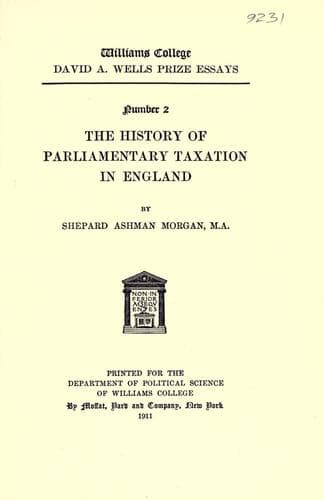
The History of Parliamentary Taxation in EnglandMorgan, Shepard Ashman
History
The History of Parliamentary Taxation in England
Morgan, Shepard Ashman
Taxation -- Great Britain; Taxation -- Great Britain -- History
National Council, its powers and composition under Norman Kings, 14;
its part in taxation, 15-16;
under Henry I, 22-24;
its place under Richard I, 43;
townsmen present at Council of St. Albans, 58;
representation of shires at Oxford, 59.
New Customs, 158;
tentative abolition of, 162, 164;
abolished in 1311, 165;
restored for a year, 1322, 168, note 1;
a regular means of revenue, 1328, 172.
Normandy, loss of, 1204, 56-57.
Normans, character of their rule, 12-13.
Northampton and York, provincial assemblies at, 1283, 117-119.
Nottingham, Council of, 1194, 42.
Offices, sale of, under Richard I, 42.
Oxford, John’s council at, 59.
Oxford, Provisions of, 97-99.
Parliament, first use of the name, 95, note 1;
refusal of aid, 1255, 96;
knights of the shire summoned to, 99-100;
they attend Parliament, 1264, 101;
Simon de Montfort’s Parliament of 1265, 102, 103;
Parliament of 1269, 105;
first Parliament of Edward I, 109-110, 114;
events leading to the Model Parliament, 127-128;
“What affects all, by all should be approved,” 128-129;
session of the Model Parliament, 131;
Parliament of 1296, 132;
status in 1297, 152;
process of differentiation in, 154-156 ff.;
statute providing for taxation solely by Parliament, Edward III,
177-179;
increase in power under Edward III, 188-189;
separate sessions of the houses, 189;
control over taxes, Richard II, 194-197, 199;
delay of grants to end of session, 204;
initiation of tax levies, 205-208;
of Henry VIII, 219;
Wolsey’s breach of privilege, 223;
attitude toward the Bate Case, 244, 246-248;
the Addled Parliament, 251;
enactment of the Petition of Right, 269 ff.;
the Short Parliament, 292-294;
the Long Parliament, 295-301;
declares against illegal taxation, 297;
the Grand Remonstrance, 300-301.
Personal property, see Movables.
Petition of Right, 267-273.
Poll-tax, under Richard II, graduated, 194, 197;
excites the Rising of the Villeins, 198.
Prisage, early rate, 113, note 1.
Purveyance, early analogy of, 5-6.
_Quo Warranto_, a writ, 116.
Ralegh, William de, his offer of a disbursing commission, 82-83.
Redress of grievances, principle of, in 1297, 144-145;
principle adhered to, James I, 252, 254-255;
under Charles I, 262-263.
Reformation, profits of, 228-230.
Representation, under the charter, 68, 69, 70;
as it was in Henry III’s National Council, 91-92;
development of the principle in Simon de Montfort’s Parliament,
101-104;
under Edward I, 108-109.
Richard I, accession of, 38;
his ransom, 39-40;
general taxation under royal authority, 41;
release and subsequent levies, 42-44.
Richard II, accession, 190;
summary of taxes in his reign, 194, note 3;
resignation and deposition, 200-202.
Public-domain text, read in full here on John Shaqi.
Reviews
Reviews
No reviews yet
Be the first to share your thoughts on this work.
Elsewhere in the archive
Join the Discussion
Join the discussion
Sign in to leave a comment or review.
Sign InorCreate an account