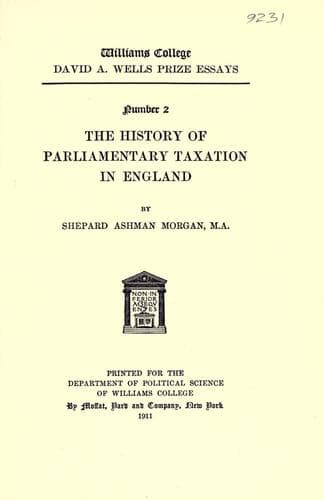
The History of Parliamentary Taxation in EnglandMorgan, Shepard Ashman
History
The History of Parliamentary Taxation in England
Morgan, Shepard Ashman
Taxation -- Great Britain; Taxation -- Great Britain -- History
Richard III, accession, 216;
benevolences prohibited, 216-217.
St. Albans, Council of, 58-59.
Salisbury, Gemôt of, 13, note.
Scutage, definition of, 30;
early instances, 31;
the Great Scutage, 32-33;
complaint of Archbishop Theobald, 34;
a cause leading to Magna Carta, 50;
list of John’s scutages, 51, and note 1;
fines and other attendant abuses under John, 53-54;
scutage of 1214 precipitates the movement for the Charter, 60;
specified in Magna Carta, 64;
referred to in Henry III’s second reissue, 75;
practice of scutage by consent, Henry III, 76;
scutage of 1242, 86.
Sheriff’s aid, 27, 29.
Ship-money, a precedent in the Danegeld, 10-11;
requisition of ships under Charles I, 264;
first writ, 281;
its object, 283;
second and third writs, 284-285;
extra-judicial opinions, 285-286;
Hampden’s Case, 287-291, 293;
new levy, 294;
declaration of illegality by Long Parliament, 298.
Shire moots, their utilization in taxing, 21.
Star Chamber, its utility in forced loans, 251.
_Statutum de tallagio non concedendo_, 150, 151, 159, 167;
cited in Petition of Right, 271.
Stephen, 24-26.
Subsidy, the “new-found,” 219-220;
value of under Elizabeth, 234, note 1.
Supplies, appropriation of, see under Appropriation.
Tallage, under Henry II and Richard I, 47, note 1;
definition of, 65, note 1;
possibly provided against in Magna Carta, 65-66;
Kirkby’s tallages, 1290, 120;
tallage not referred to in _Confirmatio Cartarum_, 149;
the “statute” _De Tallagio non Concedendo_, 150-151;
tallage of 1304, 159;
tallage of 1312 resisted, 167;
revival under Edward III, 170;
its withdrawal, 171;
a function of Parliament, 177-178.
Theobald, Archbishop, his complaint against scutage, 34.
_Trinoda necessitas_, 4.
Tudors, character of their reigns, 217-219.
Tunnage and poundage, in _Carta Mercatoria_, 158;
given James I for life, 239;
delay in grant to Charles I, 261, 263;
arbitrary levies, 273;
Charles renounces tunnage and poundage, 274-275;
failure to pass a life allowance, 275-276;
tumult over the Rolles case, 277;
resolution against the levies, 278;
reëstablishment, 280;
declaration of illegality, 297.
Villeins, Rising of, 198-199.
Wallingford, treaty of, 26.
Walter, Hubert, justiciar, at Richard I’s Council of Oxford, 44-45.
Westminster, Statute of, 110-111.
William the Conqueror, character of his rule, 13;
attitude toward his National Council, 14.
William and Mary, 306-308.
William Rufus, character of his reign, 17-18.
Winchester, Bishop of, his refusal of assent, 69.
Witenagemot, folkland alienable only by its consent, 4;
assents to levies of Danegeld, 8;
powers and composition, 9-11.
Wolsey, Cardinal, his breach of Parliamentary privilege, 222-224.
Woodstock, Controversy of, 27-30.
Public-domain text, read in full here on John Shaqi.
Reviews
Reviews
No reviews yet
Be the first to share your thoughts on this work.
Elsewhere in the archive
Join the Discussion
Join the discussion
Sign in to leave a comment or review.
Sign InorCreate an account