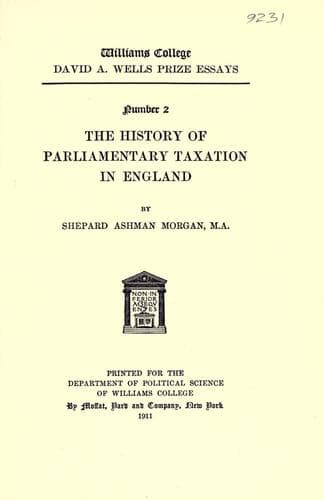
The History of Parliamentary Taxation in EnglandMorgan, Shepard Ashman
History
The History of Parliamentary Taxation in England
Morgan, Shepard Ashman
Taxation -- Great Britain; Taxation -- Great Britain -- History
[32] Bishop Stubbs (1 _Const. Hist. Eng._ 500) believes this struggle
between Henry II and Becket to have been the deathblow to the levy of
the Danegeld, which is not noted in the Pipe Rolls after 1163. J. H.
Round [_Feudal England_, 497-502, in the paper “The Alleged Dispute
on Danegeld (1163)”], effectually establishes his contention that the
tax in question was not the Danegeld, but the “auxilium vicecomitis”
or “Sheriff’s aid,” which was a customary, variable charge paid over
locally to the sheriffs in payment for their services.
[33] Round, _Feudal England_, 501.
[34] Baldwin, _Scutage and Knight Service in England_, 12.
[35] 1 Stubbs, _Const. Hist. Eng._ 491.
[36] H. W. C. Davis, _England under the Normans and Angevins_, 205.
[37] Miss Kate Norgate, _Angevin Kings_, 432.
[38] 1 Stubbs, _Const. Hist. Eng._ 494.
[39] Baldwin, _Scutage and Knight Service in England_, 5.
[40] 2 Stubbs, ed. _Gesta Regis Henrici Secundi Benedicti Abbatis_,
preface xcv-xcvii, cites other instances of scutage in this reign:
1161, for debts incurred in the Welsh war; 1172, for the expedition
into Ireland; 1186, for the expedition into Galloway against the Irish
prince, Ronald.
[41] Gervas, c. 1381, in Stubbs, _Select Charters_, 129: Hoc anno
(1159) rex Henricus scutagium sive scutagium de Anglia accepit, cujus
summa fuit centum millia et quater viginti millia librarum argenti.
[42] _Liber Rubeus de Scaccario_, Hubert Hall, editor, 6, 16-18.
[43] John of Salisbury, ep. 128, noted by 1 Stubbs, _Const. Hist. Eng._
492, note 1.
[44] Round, _Feudal England_, 274.
[45] The Danegeld disappears from the Rolls in 1163. It persists,
probably, however, as a “donum” or an “auxilium.” The “carucage” of
Richard I is the Danegeld under another name.
[46] 2 Benedict, 278. Also in Stubbs, _Select Charters_, 153.
[47] 2 Benedict, 33.
[48] Beside the instances of taxation noted above, the following are
noteworthy: 1168, a regular feudal aid, _pur fille marier_ of one mark
on the knight’s fee; 1173, exchequer officers held courts and exacted
at the same time a tallage throughout the country.
[49] The three auxilia are: For the ransom of the king, for the
marriage of the king’s eldest daughter, and for the knighting of his
eldest son.
[50] Other scutages in this reign were: 1189, 10_s._ on the knight’s
fee for a pretended expedition into Wales; 1195, 20_s._ on the knight’s
fee from those who did not follow the king to Normandy; 1196, 20_s._
for the same reason. 1 Dowell, _Taxation and Taxes_, 41.
[51] 3 Rogeri de Hoveden, _Chronica_, W. Stubbs, ed, 209-225.
[52] This carucage appears in the Rolls under the year 1194. It was
demanded at the Council of Nottingham.
[53] Rogeri de Hoveden, preface to vol. IV, lxxxii-lxxxvii.
[54] The mark was the equivalent of two-thirds of a pound.
Public-domain text, read in full here on John Shaqi.
Reviews
Reviews
No reviews yet
Be the first to share your thoughts on this work.
Elsewhere in the archive
Join the Discussion
Join the discussion
Sign in to leave a comment or review.
Sign InorCreate an account