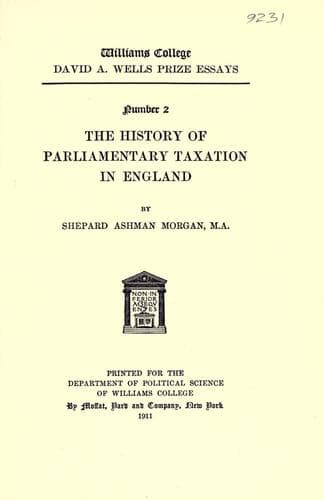
The History of Parliamentary Taxation in EnglandMorgan, Shepard Ashman
History
The History of Parliamentary Taxation in England
Morgan, Shepard Ashman
Taxation -- Great Britain; Taxation -- Great Britain -- History
[250] The taxes during the reign in summary:--Parliament of October,
1377. Two tenths and two fifteenths. 3 _Rot. Parl._ 7. Parliament of
October, 1378. An increase of custom on wool and merchandise over the
grant to Edward III in 1376. 3 _Rot. Parl._ 37. Parliament of April,
1379 (another session of the last Parliament). Superseded the above
tax on wool, which had proven to be insufficient, with a graduated
poll-tax which varied according to the position of the taxpayer. A
tax of a groat a head had been levied in 1377, but this was the first
instance of a poll-tax of varied incidence. The payments: The Dukes of
Lancaster and Bretagne, ten marks each; earls or their widows, four
pounds; barons and baronets, two pounds; and so on down to persons of
the lowest rank, who were to pay a groat apiece. (Further details, 1
Dowell, _Taxation and Taxes_, 94.) Proceeds were to be strictly for
national defense. Produced about half as much as was expected, only
£22,000. 3 _Rot. Parl._ 57-58, 72-73. Parliament of 1380. A tenth and
a half and a fifteenth and a half with a year’s subsidy on wool. A
second Parliament, finding this amount insufficient, in the same year
undertook to raise the “outrageous and intolerable” amount, £160,000.
The means was another graduated poll-tax, varying from sixty groats to
three, together with a continuance of the subsidy on wool, a custom
which netted about £60,000 annually. The clergy undertook to raise
their share of the money. The poll-tax was expected to bring about
£66,000. 3 _Rot. Parl._ 75, 90. Parliament of 1382. A fifteenth and
a tenth, to be devoted wholly to the defense of the realm. Tunnage
and poundage for two years. 3 _Rot. Parl._ 124, 134. Parliaments of
1383. Grant of fifteenth and tenth made in 1382, given to Bishop of
Norwich who was warring against the anti-pope in Flanders. He was
held to account at the October session. Two half tenths and two half
fifteenths were granted by the commons, one-half without condition,
and the other half for the prosecution of the war if it be prolonged.
Clergy made similar grants. 3 _Rot. Parl._ 151-152. Parliament of
1384. At spring session half a tenth and fifteenth. At fall session,
two tenths and fifteenths, one of which was remitted the following
spring. The object was the prosecution of a war in Scotland. 3 _Rot.
Parl._ 167, 185, 398. Parliament of 1385. Granted a fifteenth and a
half and a tenth and a half. Wool subsidy renewed for another year.
3 _Rot. Parl._ 204. Parliament of 1386. Half a tenth and fifteenth,
with duplication if exigencies of war demanded. Continuance of subsidy
on wool and merchandise, the object being for naval defense. Before
Richard could obtain this grant, he had to consent to the appointment
of a commission of reform to correct the irregularities in the realm
and in his household. 3 _Rot. Parl._ 220-221. Parliaments of 1388.
First session. Half a tenth and fifteenth with tunnage and poundage and
the custom on wool.
Public-domain text, read in full here on John Shaqi.
Reviews
Reviews
No reviews yet
Be the first to share your thoughts on this work.
Elsewhere in the archive
Join the Discussion
Join the discussion
Sign in to leave a comment or review.
Sign InorCreate an account