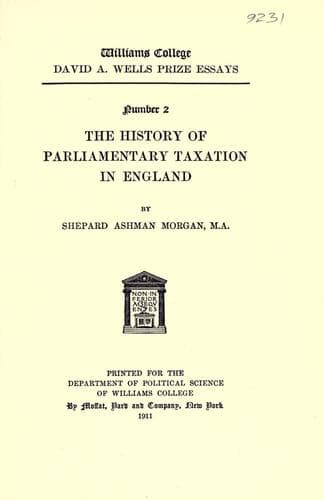
The History of Parliamentary Taxation in EnglandMorgan, Shepard Ashman
History
The History of Parliamentary Taxation in England
Morgan, Shepard Ashman
Taxation -- Great Britain; Taxation -- Great Britain -- History
[216] 2 Stubbs, _Const. Hist. Eng._ 398, 555, with authorities there
cited. The statute is given in 1 Hall, _Hist. of Customs_, 210-211.
[217] 2 _Rot. Parl._ 104.
[218] 2 Ibid. 105.
[219] 2 _Rot. Parl._ 107-108.
[220] 2 Ibid. 112-113. 2 Walt. de Hemingb. 354.
[221] 14 Edw. III, 1, in 1 _Statutes of the Realm_, 281, and in Adams
and Stephens, _Sel. Doc._ 103-104.
[222] 14 Edw. III, 2, in 1 _Statutes of the Realm_, 281, and in Adams
and Stephens, _Sel. Doc._ 104-105.
[223] The definite inclusion of tallage within the scope of these
charges and aids prohibited to the royal control had to be asserted
further: 1348. Condition of the grant made by Parliament that no
tallage or similar exaction should be imposed by the Privy Council. 2
_Rot. Parl._ 200; Adams and Stephens, _Sel. Doc._ 113. 1352. The king
openly declares that he is not intending again to impose a tallage.
2 _Rot. Parl._ 238. 1377. Parliament petitions, nearly in the words
of the statute of 1340. King replies that only a great exigency would
induce him to disregard the petition. 2 _Rot. Parl._ 365.
[224] 2 Stubbs, _Const. Hist. Eng._ 557.
[225] Bishop Stubbs conjectures 8th July, 1342, as the date of the
grant. 2 _Const. Hist. Eng._ 412, note 2.
[226] 2 _Rot. Parl._ 140, given in Adams and Stephens, 110.
[227] 1 Dowell, _Taxation and Taxes_, 166, citing 18 Edw. III, 2 c. 3.
[228] 2 _Rot. Parl._ 161.
[229] 2 _Rot. Parl._ 200. A translation is given in Adams and Stephens,
113-114.
[230] 2 Stubbs, _Const. Hist. Eng._ 418.
[231] 1 _Statutes of the Realm_, 371. Translation in Adams and
Stephens, _Sel. Doc._ 128; 2 _Rot. Parl._ 271.
[232] 2 _Rot. Parl._ 308.
[233] In 1334 the fifteenth and tenth was compounded for by a fixed
sum, rather than in accordance with a strict assessment. Hereafter each
town and each county knew for how much it would have to answer. The
expression was the fiscal equivalent of £39,000, less about £6,000 for
decayed towns. 1 Dowell, _Taxation and Taxes_, 89.
[234] The fifteenths and tenths after 1334 noted in Dowell, 1 _Taxation
and Taxes_, 89, note. Taxation, 1351-1359, see Stubbs, 2 _Const. Hist.
Eng._ 424, note 1. Taxation, 1360-1368, see Stubbs, 2 _Const. Hist.
Eng._ 433, note 1 and p. 432.
[235] 14 Edw. III, 2.
[236] 2 _Rot. Parl._ 161, 202.
[237] 2 Ibid. 252.
[238] 2 Ibid. 114.
[239] 2 Ibid. 128. Translation given in Adams and Stephens, _Sel. Doc._
105-106.
[240] 2 _Rot. Parl._ 130, given in Adams and Stephens, _Sel. Doc._ 106.
[241] 2 _Rot. Parl._ 364, given in Adams and Stephens, _Sel. Doc._ 135.
[242] Taswell-Langmead, _Eng. Const. Hist._ 211, note 1.
[243] 3 _Rot. Parl._ 7; translation in Adams and Stephens, _Sel. Doc._
136.
[244] 3 _Rot. Parl._ 35-36. Translation in Adams and Stephens, _Sel.
Doc._ 137-138.
[245] 3 _Rot. Parl._ 36.
[246] 3 Ibid. 56. Translation given in Adams and Stephens, _Sel. Doc._
138.
[247] 3 _Rot. Parl._ 66.
[248] 3 _Rot. Parl._ 73.
[249] 3 Ibid. 124.
Public-domain text, read in full here on John Shaqi.
Reviews
Reviews
No reviews yet
Be the first to share your thoughts on this work.
Elsewhere in the archive
Join the Discussion
Join the discussion
Sign in to leave a comment or review.
Sign InorCreate an account