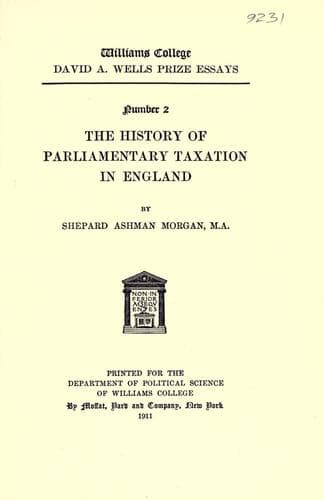
The History of Parliamentary Taxation in EnglandMorgan, Shepard Ashman
History
The History of Parliamentary Taxation in England
Morgan, Shepard Ashman
Taxation -- Great Britain; Taxation -- Great Britain -- History
The remainder of the reign of Henry II, aside from the fact that it
witnessed the temporary passing of the Danegeld,[45] derives its chief
importance by reason of the extension of taxation to cover personal
property. By the Assize of Arms in 1181, “every free layman who had
in chattels or in revenue to the value of sixteen marks” was to “have
a coat of mail and a helmet and a shield and a lance;” and “every
free layman who had in chattels or revenue ten marks should have a
hauberk and a head-piece of iron and a lance.”[46] Here was a step
toward laying movables and personal property open to taxation. Seven
years later, when Saladin had cut his way into Jerusalem, personal
property was forced to contribute toward the Crusade. This tax, the
so-called “Saladin tithe,” was laid at the Council of Geddington on
the 11th February, 1188. Present at it were archbishops and bishops
and the greater and lesser barons,[47] but it is not stated whether or
not they gave a formal consent to the levy. “This year,” so goes the
Ordinance, “each one shall give in alms a tenth part of his revenues
and movables, except the arms and horses and clothing of the knights;
likewise excepting the horses and books and clothing and vestments and
articles required in divine service of whatever sort of the clerks, and
the precious stones both of clerks and laymen.” This is the earliest
recorded instance of a general tax upon movables. For the assessment
and collection of the Saladin tithe, Henry adopted a scheme favorite
with him, which had been utilized in England for national purposes at
least since the time of the Domesday Survey. It was ordained that the
assessment be done by juries of inquest; thus the taxpayers themselves
were instruments in the determination of how much each should pay, even
though the determination of how much the gross payment should be was as
yet far beyond their power.
Henry II closed his reign in 1189. His taxation[48] had never been
exceptionally heavy, though it had been the occasion for protest and
had served as the pretext in 1174 for a little warring with his barons.
In the matter of royal authority over taxation, the power of the king
to levy taxes was not much diminished. The instances of opposition
that have been cited do not prove much more than that now and then
complaining voices were raised in the Great Council; nowhere is it
shown that the objections had more than passing value, much less that
they were conclusive.
Public-domain text, read in full here on John Shaqi.
Reviews
Reviews
No reviews yet
Be the first to share your thoughts on this work.
Join the Discussion
Join the discussion
Sign in to leave a comment or review.
Sign InorCreate an account